
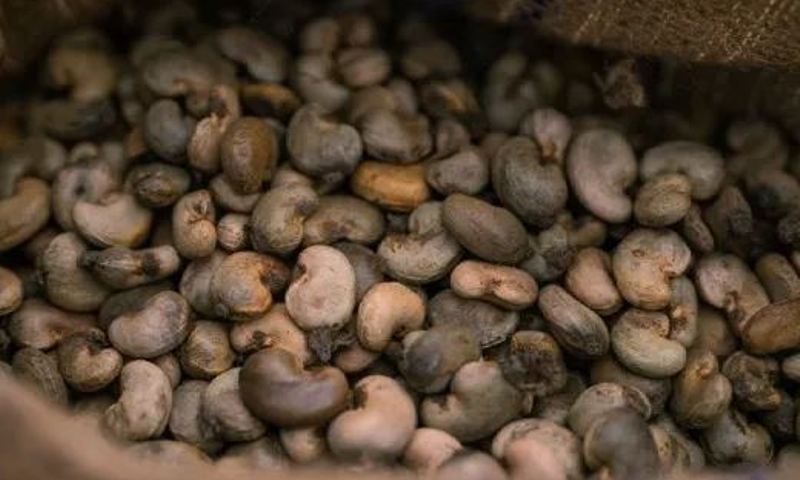
The imports of the cashew kernels in the guise of cattle feed or husk to circumvent to avoid the duty has been hitting the crisis ridden cashew industry.
The Andhra Pradesh Cashew Manufacturers’ Association (APCMA) approached the authorities to prevent the illegal imports citing that it has been creating unfair competition for domestic producers.
The APCMA led by President Phani Raghavulu, Secretary Subbarayulu, vice-president Malla Kantarao also urged the government to abolish the Agriculture Market Committee (AMC) cess on cashew kernels to ensure a level-playing field for the traders.
Kannan Malla, a young entrepreneur in the cashew trade on behalf of the APCMA mentioned that over the past five years, the cashew industry in Andhra Pradesh has been severely affected by illegal imports of cashew kernels through ports such as Kakinada, Mumbai, Chennai, Krishnapatnam, and others.
Many of these imports are being routed under wrong HSN codes, often shown as cattle feed to evade import duty and taxes.
The malpractice is clearly reflected in import statistics, showing unusually high volumes of kernel imports under these codes.
Though the All-India Cashew Association (AICA) has raised the issue with the union government, it has led to partial control.
However, the issue has now worsened as illegal imports are being increasingly routed through SEZ (Special Economic Zones) and EOUs (Export Oriented Units).
These facilities are being misused to divert kernels into the domestic market, bypassing duties. The volume of such imports has increased nearly ten times, severely destabilizing genuine processors. Additionally, it is observed that SEZ/EOU units are offering contract processing and grading services to outside parties, which is beyond their permitted scope. This creates unfair competition for regular domestic processors, the APCMA team mentioned.
In the Palasa and Kasibugga localities in Srikakulam district of north coastal Andhra Pradesh, there are over 300 cashew processing units. Normally, all the units together produce around 60,000 kg of cashew kernels per day. The processing units require at least 80,000 to 1,00,000 tonnes of raw cashew per year to produce the fine quality of cashew kernel The APCMA team pointed out that the prices of cashew kernels have fallen by 20-30 per cent due to the rise in illegal imports of the cashew kernels. Most of such cashew kernels are coming from Africa and Vietnam to some ports . They are cheaper than local cashew kernels, said vice-president of APCMA Malla Kantarao. He added that such illegal kernels are coming as cattle feed which carry no import duty or as cashew husk having negligible duty compared with around 25 to 30 per cent for cashew kernels. These imported kernels are getting sold in the domestic market, he added.
The AMC cess is being levied even on Raw Cashew Nuts (RCN) imported from foreign countries or from other states, where no local farmers or notified market yards are involved . The AMC officials are also demanding cess on cashew kernels, unless traders prove cess was already paid on the raw nut stage, leading to harassment. This causes double taxation, since kernels are a processed output and are already 7-8 times costlier than RCN. Other cashew-producing states (Odisha, Karnataka, West Bengal) do not impose AMC cess on kernels or imported RCN, which puts Andhra Pradesh manufacturers at a severe price
disadvantage, the APCMA added.