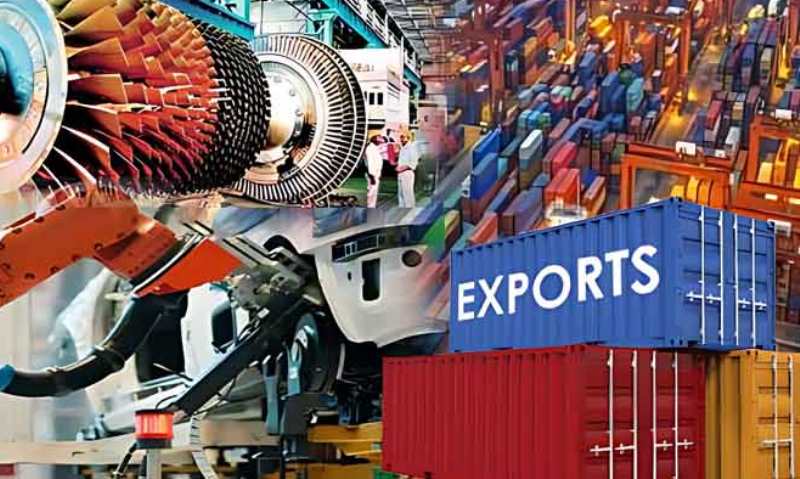
Union Minister for Commerce and Industry Piyush Goyal today said that India’s engineering exports have grown remarkably over the past seven decades—from just USD 10 million in 1955 to USD 116 billion now—making the sector one of the country’s biggest export success stories.
Speaking at the Platinum Jubilee Celebrations of EEPC India, Goyal said the engineering sector is poised for further growth, calling on industry to focus on high-value products and global trust in manufacturing quality.
“Under the leadership of Prime Minister Narendra Modi, India has moved from being among the Fragile Five economies in 2014 to one of the top five economies of the world. The Indian economy, currently at USD 4 trillion, will become the third-largest globally in the next two and a half years and is on track to touch USD 30 trillion by 2047,” he said.
He also hailed the GST Council’s September 3 rate rationalisation as a “comprehensive reform” that would boost consumption, create jobs, and accelerate growth.
Goyal further urged industries to embrace the Swadeshi movement and push for self-reliance across sectors.
Minister of State for Commerce and Industry, Jitin Prasada, highlighted that India’s exports touched a record USD 821 billion in 2024-25, combining merchandise and services, up 76% over the last decade. “Export Promotion Councils have been the backbone of India’s trade strategy, and EEPC India has been a true leader in promoting engineering exports globally,” he said.
EEPC India Chairman Pankaj Chadha acknowledged the sector’s resilience but flagged fresh challenges. He pointed out that the U.S., India’s largest export destination, has recently imposed tariffs of nearly 50% on engineering products, while the European Union is preparing to implement the Carbon Border Adjustment Mechanism (CBAM) from January 1, 2026. In addition, the EU has extended its steel safeguard measures with tariff-rate quotas until June 2026.
“These measures pose major hurdles for Indian exporters, even as they continue to uphold the sector’s legacy of quality, innovation, and reliability,” Chadha said.
