
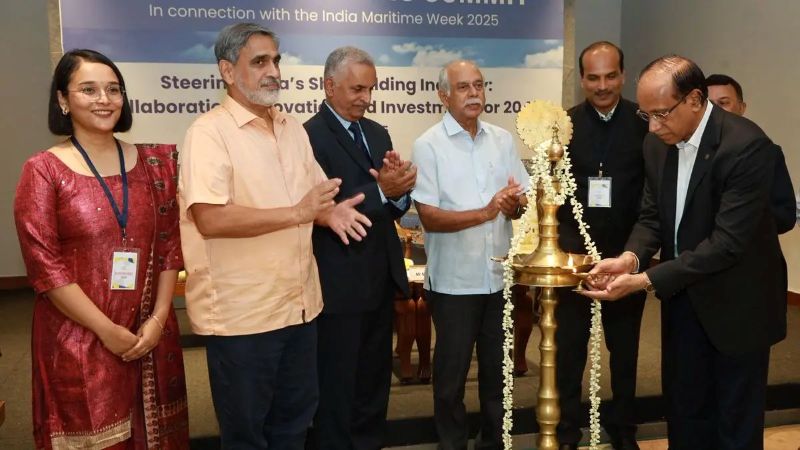
The Kochi Shipbuilding Summit 2025, jointly organised by Cochin Shipyard Limited (CSL) and the Centre for Public Policy Research (CPPR), has set an ambitious roadmap for positioning India among the world’s top five shipbuilding nations by 2047.
Held as a prelude to India Maritime Week 2025, the summit brought together leading voices from the maritime industry, academia, and policy sectors under the theme “Steering India’s Shipbuilding Industry: Collaboration, Innovation and Investment for 2047.”
Madhu S. Nair, Chairman and Managing Director of Cochin Shipyard, described shipbuilding as a “mother industry” that fuels economic growth, employment, and technological advancement. He said India’s young and skilled workforce, robust economy, and expanding domestic market make it an ideal global shipbuilding partner. “Poised for a $30 trillion GDP by 2047, India has the scale, strength, and spirit to lead the next wave of global shipbuilding,” Nair added.
Highlighting the role of research and innovation, D. Dhanuraj, Chairman of CPPR, called for stronger industry-academia collaboration to bridge capability gaps and drive technological advancement. “Building an ecosystem that fosters research, skill development, and global partnerships is key to achieving maritime leadership,” he said.
A panel discussion moderated by R. P. Pradhan, Professor at BITS Pilani, Goa, and Distinguished Fellow at CPPR, featured maritime experts including Vice Admiral G. Ashok Kumar (Retd), former Vice Chief of Naval Staff; Biju George, Director (Shipbuilding), Mazagon Dock Shipbuilders Limited; Hariraj P, COO of Smart Engineering & Design Solutions Ltd (SEDS); and Satheesh Babu P. K, Associate Professor at CUSAT.
The panel explored strategies to strengthen India’s shipbuilding competitiveness through financial reforms, technology adoption, digitalisation, and global collaboration. The experts underscored the potential of initiatives such as the Shipbuilding Financial Assistance Scheme and the Maritime Development Fund in driving sectoral growth and employment generation.
Deliberations also emphasised sustainable design, skill development, and green innovation to align with the national vision of Viksit Bharat 2047.
The summit concluded with a strong call for continued synergy among government, industry, and academia to accelerate India’s evolution from a regional shipbuilder to a global maritime hub.