
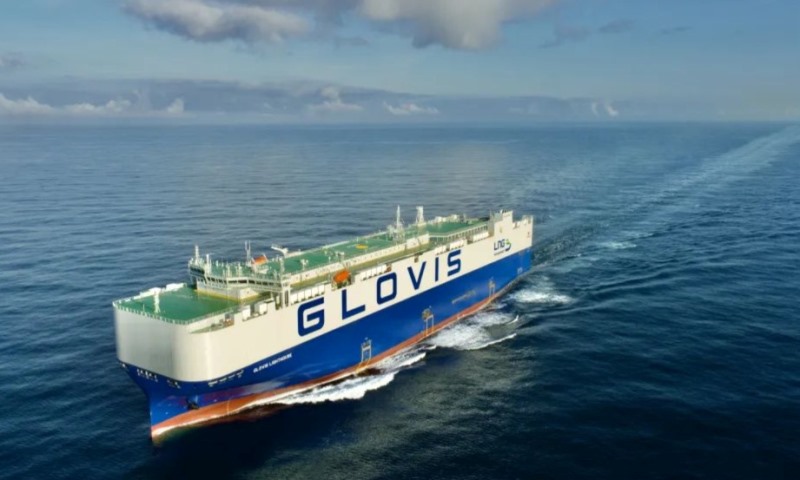
Shanghai Waigaoqiao Shipbuilding, together with CSSC Trading, has held the naming ceremony for GLOVIS LIGHTHOUSE, the first 10,800 CEU LNG dual-fuel pure car and truck carrier (PCTC) built by the Chinese shipyard for Seaspan Corporation.
The vessel will operate for Hyundai Glovis, bringing together Seaspan as owner, Hyundai Glovis as automotive logistics customer and Waigaoqiao Shipbuilding as builder.
The newbuild marks a significant milestone for Waigaoqiao Shipbuilding as its first 10,000-car-class PCTC, signalling the yard’s entry into the “10,000 CEU era” following earlier experience with 8,600 CEU and 9,000 CEU car carrier programmes.
Designed for large-scale vehicle transportation, GLOVIS LIGHTHOUSE measures 230 metres in length and 40 metres in beam. The vessel features 14 vehicle decks, including five liftable decks, and can transport up to 10,800 vehicles comprising passenger cars, SUVs, heavy commercial vehicles and new energy vehicles.
The vessel incorporates a range of green and intelligent technologies, including LNG dual-fuel propulsion, an Everllence dual-fuel main engine, a high-pressure LNG fuel gas supply system and an exhaust gas recirculation (EGR) system compliant with IMO Tier III emissions standards. Additional features include a permanent magnet shaft generator, future-ready interfaces for ammonia and methanol fuels, and enhanced fire safety and monitoring systems tailored for electric vehicle transportation.
According to SWS, the vessel’s key construction cycle was reduced by 26 per cent compared with the yard’s first 8,600 CEU dual-fuel PCTC and by 12 per cent compared with its first 9,000 CEU PCTC, reflecting improvements in construction efficiency and project execution.
Following the delivery of GLOVIS LEADER by Guangzhou Shipyard International, GLOVIS LIGHTHOUSE represents another major milestone for Chinese shipyards in the rapidly expanding 10,800 CEU PCTC segment. Subject to official delivery confirmation, the vessel is expected to further strengthen China’s position in the global large-capacity car carrier market.
For Seaspan, the vessel forms part of a broader diversification strategy beyond containerships into specialised shipping sectors including PCTCs, open hatch multipurpose vessels and large gas carriers. Despite expanding into new ship types, the company continues to focus on its long-term contract model, stable cash flow generation and partnerships with industrial customers.