
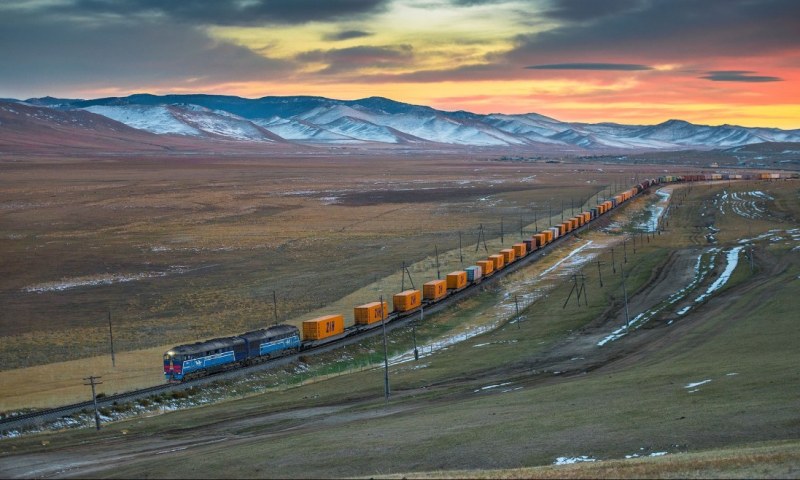
As soon as Chen Guowei had dispatched a batch of goods to Central Asia by rail in early June, he began preparing the next shipment, finalising customs clearance and inspection processes to ensure a smooth departure overseas.
This next shipment contains train wheels and cathode carbon blocks, all of which were manufactured in north China’s Shanxi Province and will be transported via the China-Europe (Central Asia) freight train service to Turkmenistan and Tajikistan.
Chen is the manager of Shanxi Daxu Logistics Co., a freight forwarding company based in Taiyuan, the capital city of Shanxi, and has witnessed the remarkable progress brought by the international rail service to this once geographically disadvantaged inland region.
“Freight forwarding companies are common in coastal areas, but in Shanxi, they were a rarity due to our geographic constraints,” Chen said. “We previously had to transport goods first to port cities like Tianjin, and relied heavily on slow sea shipping that took 50 to 60 days before cargo arrived in Europe.”
That changed in February 2017, when Shanxi’s first China-Europe freight train, loaded with heavy mining equipment, departed from the Zhongding logistics park for Lesosibirsk in Russia.
“That was truly groundbreaking,” Chen said, noting that the service has not only opened new avenues for trade but also revitalised local industries and connected enterprises in the inland province to global supply chains.
Compared to traditional sea routes, trains cut delivery time by more than half, delivering shipments to Europe in about 20 days. “It’s especially ideal for high-value and time-sensitive cargo,” he added.
Since Shanxi launched the China-Europe freight train service in 2017, the province has seen over 900 train trips, linking enterprises with markets across Europe and Central Asia.
Today, over 90 per cent of Shanxi’s China-Europe freight trains are handled by the Zhongding logistics park, which exports local specialties including train wheels, stainless steel, solar panels, pharmaceuticals, ceramics, and high-end glassware and castings. “Over the past eight years, the service’s operations have been scaled up dramatically, expanding from a few trips a year to weekly departures. The network now spans 19 routes, reaching over 40 cities across 15 countries,” said the company’s General Manager Qiao Cai.
The China-Europe freight train service has become a key logistics solution for Shanxi’s manufacturers and has also helped boost cargo trade for neighbouring provinces, effectively transforming China’s inland regions into international trade gateways, said the company’s Deputy General Manager Wang Guoqing.
According to China State Railway Group Co Ltd, 128 Chinese cities have joined the China-Europe freight train service network, reaching 229 cities in 26 European countries and over 100 cities in 11 Asian countries.
The service now carries products across 53 categories and over 50,000 varieties, with high-value-added goods such as auto parts, mechanical equipment, and electronic and electrical products becoming its primary export commodities.