
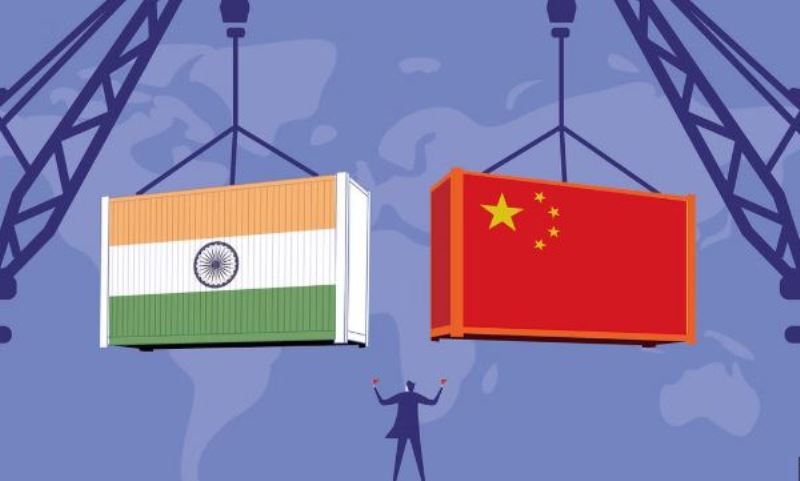
China accounted for at least 80% of India’s imports across 71 tariff lines at the eight-digit level during 2025-26, highlighting significant concentration in several critical product categories. The findings come from a study by the Koan Advisory Group and the Institute of Chinese Studies (ICS).
The study found that 46 of the 71 tariff lines crossed the 80% import-share threshold only after 2018-19, indicating that India’s dependence on Chinese supplies has increased in several categories over recent years.
The concentration is particularly visible in electrical and electronic equipment covered under HS Chapter 85, which includes semiconductor devices, lithium-ion batteries, motors, cables, switching equipment and other components that are important to India’s industrial and strategic supply chains.
India’s trade deficit with China reached $112.1 billion in 2025-26, its largest bilateral trade deficit. Electrical machinery and electronic equipment alone contributed $43.1 billion, or around 38% of the total deficit.
The report argues that the issue is not simply a dependence on low-cost finished products. Instead, it reflects deep integration of Chinese components into Indian and global manufacturing supply chains, along with gaps in domestic production capacity.
The study recommends a targeted localisation strategy rather than attempting to abruptly reverse existing trade flows. Building domestic capabilities in critical components while maintaining access to established international supply chains could help India increase domestic value addition and reduce vulnerabilities over time.
The findings underline the challenge facing India as it seeks to strengthen domestic manufacturing while remaining integrated with global supply chains, particularly in electronics, clean energy, electric mobility and other technology-intensive industries.