
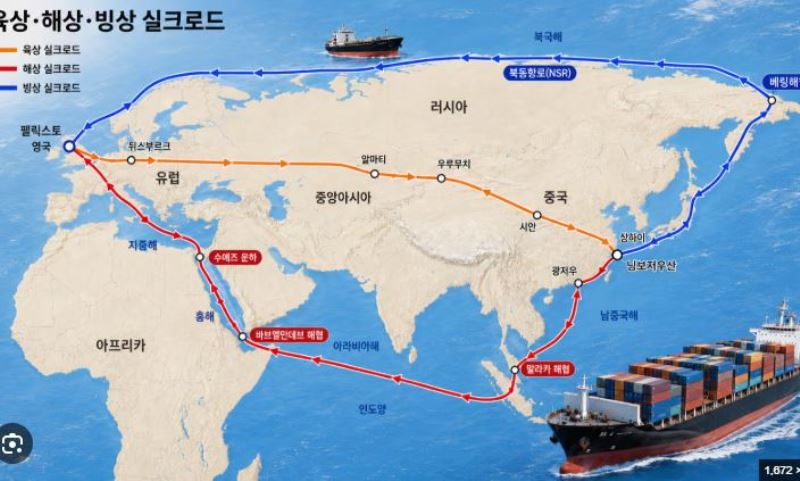
China is testing a new fast-sea freight corridor to Europe through Russia’s Northern Sea Route (NSR), with the service aiming to bring ocean transit times closer to China–Europe rail while offering greater capacity than air freight.
The container ship Dubai Tower departed Ningbo on August 15, launching the first of eight planned weekly voyages to European destinations. Operated by Sea Legend, the service is expected to take around 20 days to reach Felixstowe in the UK, compared with approximately 25 days by rail, around 40 days via the Suez Canal and up to 50 days around the Cape of Good Hope.
The service is targeting high-value and time-sensitive cargo, particularly Chinese new-energy products. Dubai Tower is carrying energy-storage systems, power batteries, photovoltaic components and other specialised exports. Chinese battery manufacturer EVE Energy has also loaded a trial shipment, including refrigerated containers, to evaluate transport conditions, temperature control and customs procedures along the Arctic route.
Chinese transport authorities have identified cross-border e-commerce and other high-value exports as key potential markets. Such cargo requires faster delivery but can be too bulky or expensive for air transport.
The Arctic service is also being developed as a network rather than a one-off voyage. Cargo is being sourced from multiple Chinese ports, while the 2026 rotation includes Felixstowe, Rotterdam, Hamburg and Gdynia, providing access to major European markets.
However, the current operation remains a controlled commercial test. Sea Legend’s schedule covers eight voyages with a combined capacity of approximately 15,700 TEU, far below the capacity of a single ultra-large container vessel operating on major Asia–Europe routes. The company is testing whether a fleet of seven ice-strengthened ships can maintain a weekly schedule, attract repeat customers and achieve commercially viable operating economics.
Over the next three to five years, Sea Legend aims to establish a stable three-to-four-month Arctic navigation window and increase operations to 12–16 sailings annually. Year-round navigation is considered a longer-term objective and would require further investment in vessels and Arctic infrastructure.
Russia and China are also advancing cooperation on logistics technology and infrastructure development along the Northern Sea Route, potentially supporting the corridor’s future expansion.
The most important measure of success will come after the final 2026 voyage. If customers return to the route in 2027, the Northern Sea Route could begin evolving from a seasonal experiment into a repeatable maritime express corridor for time-sensitive Chinese exports.
The objective is not necessarily to replace the Suez Canal, but to create another option—making Asia–Europe trade less dependent on a single long-distance maritime route.