
Egypt has strengthened its economic and strategic partnership with Djibouti by signing a series of cooperation agreements spanning maritime transport, logistics infrastructure and renewable energy, marking a new phase in bilateral collaboration between the two countries.
The agreements were signed during an official visit to Djibouti by Egypt’s Deputy Prime Minister for Industrial Development and Minister of Industry and Transport, Kamel Al-Wazir, who led a high-level delegation comprising representatives from Egyptian government entities and leading private sector companies.
During the visit, Al-Wazir held extensive discussions with officials from the Djibouti Ports and Free Zones Authority (DPFZA), focusing on Djibouti’s growing demand for Egyptian expertise in port development, logistics zones, road construction and renewable energy projects, including solar and wind power. Egyptian companies participating in the delegation confirmed their readiness to deliver large-scale projects in line with international technical and environmental standards.
Talks also reviewed progress under an existing memorandum of understanding between Egypt’s Holding Company for Maritime and Land Transport and the DPFZA. Key projects under consideration include the development of National Road RN18, renewable energy initiatives, a proposed wind farm within the International Free Zone, and major port expansion projects aimed at enhancing Djibouti’s role as a regional trade and transshipment hub.
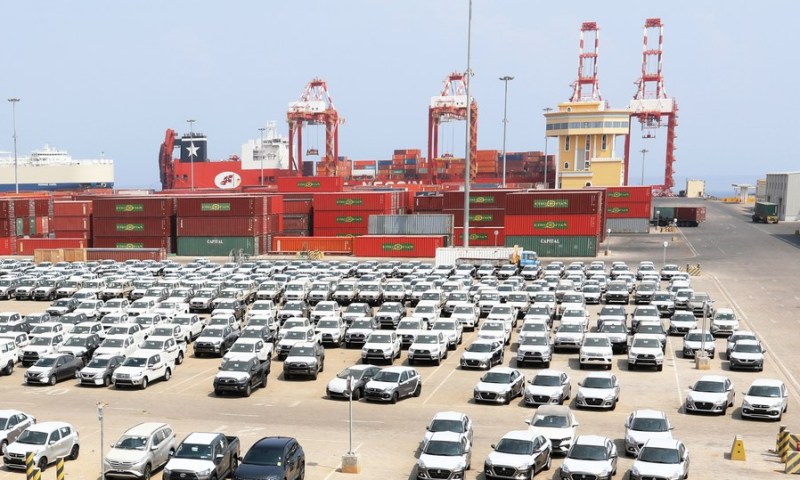
As part of the visit, the Egyptian delegation conducted site inspections at the Doraleh Container Terminal, the planned location of a solar power facility within the port, and a proposed logistics zone, according to local media reports.
Three landmark agreements
Three major agreements were signed during the visit:
-
A terms and conditions agreement for the development of a new multi-purpose terminal, involving an Egyptian consortium in partnership with Great Horn Investment Holding.
-
An agreement between the Holding Company for Maritime and Land Transport, Elsewedy Group, and the DPFZA to establish a regional logistics hub serving East Africa and Red Sea trade routes.
-
A deal between Elsewedy Electric and the operator of the Doraleh Container Terminal for the Green Port Solar Project.
The Green Port Solar Project is designed to support sustainable port operations by providing clean and stable energy, reducing reliance on fossil fuels and shielding port operations from global fuel price volatility. The project is also expected to reinforce Djibouti’s position as a key maritime gateway in the Horn of Africa while strengthening Egypt’s regional footprint in infrastructure and renewable energy development.
Building on presidential momentum
Al-Wazir highlighted the strong historical ties between Egypt and Djibouti, reaffirming Cairo’s commitment to implementing the outcomes of President Abdel Fattah Al-Sisi’s official visit to Djibouti in April 2025. He pointed to the inauguration of Banque Misr Djibouti in November 2025 and the launch of a solar power station in the Arta region as concrete results of that high-level engagement.
“These agreements reflect the depth of strategic relations between Egypt and Djibouti and our shared vision for sustainable development, regional integration and economic growth,” Al-Wazir said, adding that Egypt views Djibouti as a vital partner in Red Sea and African trade corridors.
The latest agreements underscore both countries’ ambitions to expand cooperation across transport, energy and logistics, positioning Djibouti as a regional hub and Egypt as a key partner in Africa’s infrastructure and green energy transformation.