
Shippers feel paralysed by the uncertainty thrown up by the sweeping new US tariff regime – but forwarders could win big from the chaos.
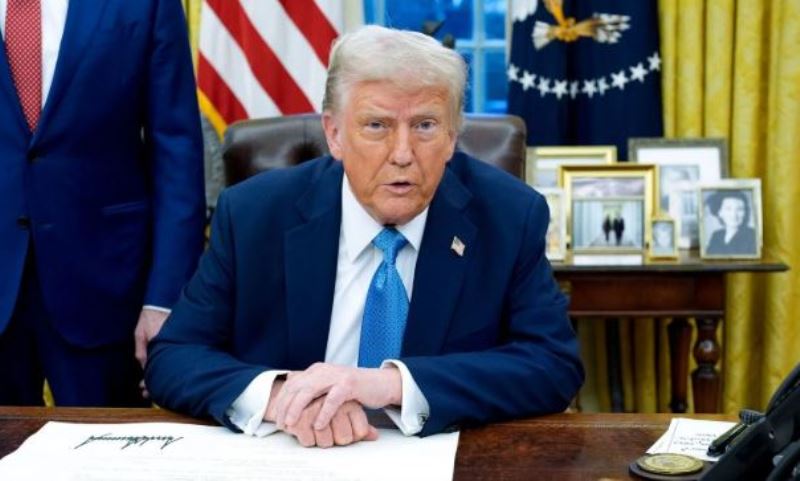
President Trump announced what has been dubbed “the big one” and “liberation day” last night, imposing a base 10% on all imports, but countries he deems to have engaged in egregious trade policies against the US are hit with tariffs of as much as 46%.
Responding to the news during DHL’s capital markets days, CEO Tobias Meyer admitted the company had “no clue” how to respond to the tariffs.
Some forwarders, however, appear less fazed, one telling The Loadstar that while “the American consumer will be reeling for months”, the situation was “not as dark as you would imagine”.
They added: “Cars, steel, and aluminium are a slightly different subject but that is already out there in the public domain. That will definitely have a major impact, and you would not want to be one of those ro-ro operators that invested in additional capacity over recent years planning on the US being the prize.”
Transport Intelligence founder John Manners-Bell suggested “the increased complexity of the administration of tariffs will help many freight forwarders improve their yields”.
He added: “Many global logistics companies are benefiting from increased interest and usage of warehousing facilities in US free-trade zones, which allow for goods to be stored and, in some cases, manufactured without incurring tariffs.”
Even so, he suggested, the long-term impact from a potential reduction in global trade would likely affect everyone.
Many companies and countries appear to be hoping for a “carve-out” from the tariffs, the likes of BMW confirming it would absorb the extra costs, rather than passing them on to US consumers.
It has also been reported that certain sectors, including pharmaceuticals, are pushing for a phased-in approach that would give them time to set up US manufacturing sites.
How willing President Trump is to offer this is unknown, but UK government sources told media efforts to land a carve-out failed, because the president did not want “to dilute the spectacle” until after the new regime had been imposed.
Vespucci Maritime CEO Lars Jensen said President Trump had “essentially launched a trade war on the entire world”.
Noting that shippers would be “working overtime” to assess the impact on their supply chains, he pointed out that “the listed tariffs only apply to the non-US content of the goods imported if at least 20% of the value of the goods is originating in the US”.
“This is likely to dramatically increase the workload for shippers scrambling to demonstrate US content value, and for Customs to verify such claims,” he added.
The hardest-hit countries are Cambodia (a tariff of 49%), Vietnam (46%), and Bangladesh and Thailand (both 37%), but while yesterday’s news was that China would be hit with a new 34% tariff, Mr Jensen noted pre-existing duties effectively raised that to 54%.
Canada (25%) and the EU (20%) have both vowed to retaliate with measures of their own. But with a threat of increased tariffs on countries that engage in retaliation, there has been acceptance from some trading partners that there is little they can do.
Citing consultant Oxford Economics, Mr Manners-Bell suggested that the European Union may still fight back. The consultant’s report notes that “neither the EU nor the US have much supply chain reliance on one another. This may make tariffs more justifiable from President Trump’s perspective and embolden the EU to retaliate”.
Mr Manners-Bell said this suggested “the severity of impact will be limited to certain parts of the economy, rather than more generalised”.
He added: “Against this is the argument that, regardless of levels of integration, global GDP will be impacted, and this will affect all countries, whether they have the highest or lowest levels of tariffs imposed upon them.”