
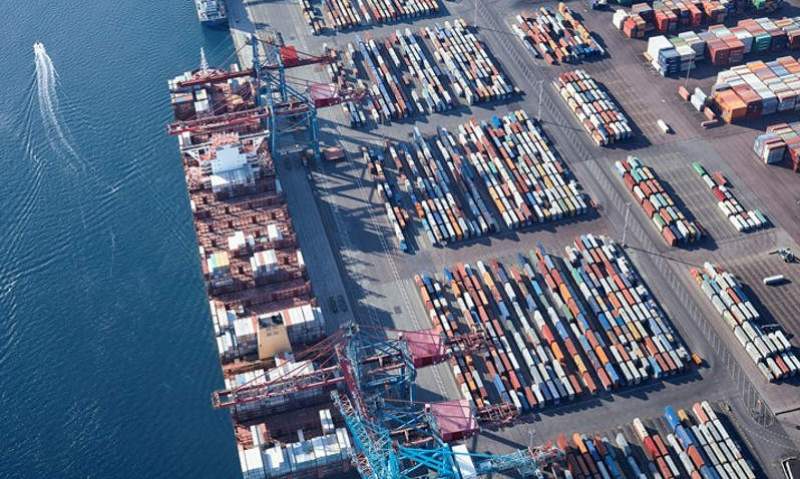
The Port of Gothenburg handled 470,000 containers (TEU) in the first half of 2025, unchanged compared with the same period in 2024.
According to the company’s release, efficiency improved as the share of fully loaded containers rose and repositioning of empty units decreased.
“Repositioning empty containers between ports is necessary for the logistics system to function, but ideally it should be kept to a minimum. The fact that we are handling more loaded containers while managing fewer empties reflects greater efficiency across the entire logistics chain,” said Claes Sundmark, Vice President Sales and Marketing at the Port of Gothenburg.
APM Terminals, the operator of the port’s container terminal, recorded its best month in July with 47,805 TEU handled, a result that will be reflected in the next quarterly report.
Over the summer, CMA CGM introduced a Gothenburg–Baltic service, while Maersk and Hapag-Lloyd launched a new direct connection to Asia.
Rail freight reached record levels, with 260,000 TEU moved in the first half of the year, up 4 percent from 2024. More than 60 percent of container volumes now move by rail, supported by inland terminals across Sweden. In the Stockholm region alone, rail container traffic increased by 4 percent to more than 30,000 TEU.
“The region hosts numerous central warehouses, particularly for consumer goods, and the rail link to the Port of Gothenburg is vital. Rail is efficient, nearly emission-free, and helps ease road congestion,” Sundmark said.
Other cargo flows showed mixed results. Intra-European RoRo traffic rose 1 percent to 272,000 units after a weak first quarter.
Car handling fell 7 percent to 124,000 vehicles.
Energy volumes dropped 13 percent to 9.4 million tonnes due to lower refinery margins and maintenance shutdowns.
Dry bulk decreased 43 percent to 155,000 tonnes, reflecting weaker demand for construction materials.
Processed forest products continued to grow, while cruise ship calls fell to 19 from 26 in the same period last year.
The Port of Gothenburg is a municipal company owned by the City of Gothenburg, Sweden. It is Scandinavia’s largest seaport and operates as a full-service logistics hub with container, ro-ro, energy, vehicle, bulk, and passenger terminals.
APM Terminals is a global port and terminal operator headquartered in The Hague, Netherlands. It is part of A.P. Møller – Mærsk A/S and operates a portfolio of terminals worldwide under long-term concession agreements.