
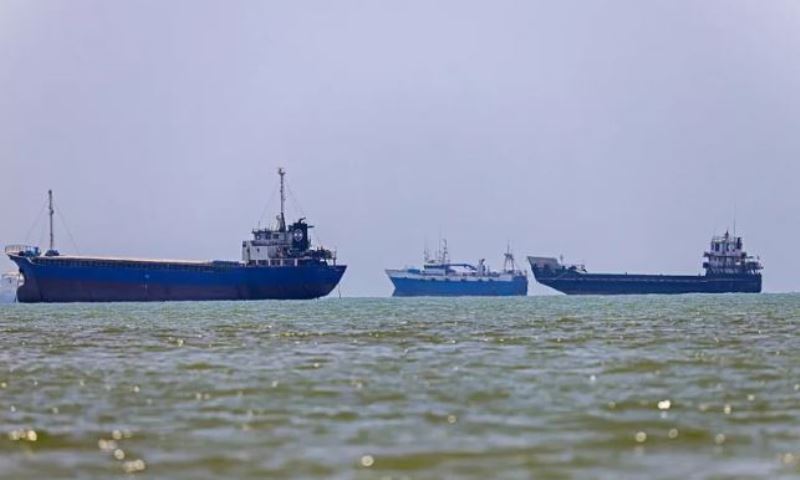
Three Saudi crude oil tankers carrying cargoes destined for India and China have altered their voyages in the Red Sea after Yemen’s Iran-backed Houthi movement warned shipping companies against calling at Saudi Arabian ports, raising fresh concerns over the security of one of the world’s most critical maritime trade routes.
According to Reuters, the tankers Xin Long Yang, Rodos, and Amazon changed course rather than continue toward the Bab el-Mandeb Strait after the Houthi warning, highlighting the growing risks facing global energy shipping amid escalating tensions in the Middle East.
The latest disruption comes as global oil markets are already grappling with the continued closure of the Strait of Hormuz, forcing exporters to rely increasingly on Saudi Arabia’s Red Sea port of Yanbu as an alternative export gateway.
Houthi Warning Raises Security Risks
The Iran-aligned Houthis this week announced what they described as a naval blockade against Saudi Arabia, warning shipping companies not to load or discharge cargo at Saudi ports.
In communications sent to ship operators, the group warned that vessels involved in Saudi port calls could be targeted “in any location.” The warning has significantly heightened concerns for ships transiting the Bab el-Mandeb Strait, the strategic waterway linking the Red Sea with the Gulf of Aden and the Indian Ocean.
Maritime security firm Ambrey advised shipowners to reconsider Red Sea transits involving Saudi Arabian ports and recommended enhanced security measures, noting that vessels calling at Saudi ports now face a high-risk operating environment.
Tankers Bound for India and China Reverse Course
Shipping data showed that the VLCC Xin Long Yang, carrying approximately 2 million barrels of Saudi crude for China after loading at Yanbu, made a U-turn in the Red Sea and headed north toward the Suez Canal.
Two tankers carrying Saudi crude for India also altered their voyages:
Rodos, carrying around 700,000 barrels of crude.
Amazon, a Suezmax tanker loaded at Yanbu.
Both vessels reportedly changed course toward the Suez Canal before switching off their AIS transponders.
Another VLCC, New Prime, scheduled to load crude at Yanbu later this week, also reportedly turned back off the coast of Oman before entering the Red Sea.
Insurance Costs Climb
The heightened security risks have already begun affecting shipping economics.
Insurance industry sources indicated that war-risk premiums for vessels calling at Saudi ports have increased, while underwriters are reassessing exposure for ships operating in the Red Sea.
Most crude tankers currently loading at Yanbu or sailing through the Red Sea have reportedly switched off their tracking transponders as a precaution.
Potential Impact on Global Oil Trade
Since the disruption in the Strait of Hormuz, Yanbu has become Saudi Arabia’s principal alternative export outlet, enabling millions of barrels of crude oil per day to reach international markets.
However, any disruption at the Bab el-Mandeb could significantly complicate crude exports to Asia.
Fully laden Very Large Crude Carriers (VLCCs) cannot transit the Suez Canal at full draft and typically discharge part of their cargo for transport via Egypt’s SUMED Pipeline before reloading in the Mediterranean.
Shipping analysts warn that if security conditions deteriorate further, cargo flows could be reshaped, with more Saudi crude being redirected to European buyers while Asian importers face longer voyages and higher freight costs via routes around the Cape of Good Hope.
The developments underline the growing vulnerability of global energy supply chains as geopolitical tensions simultaneously threaten both the Strait of Hormuz and the Bab el-Mandeb, two of the world’s most strategically important maritime chokepoints.