
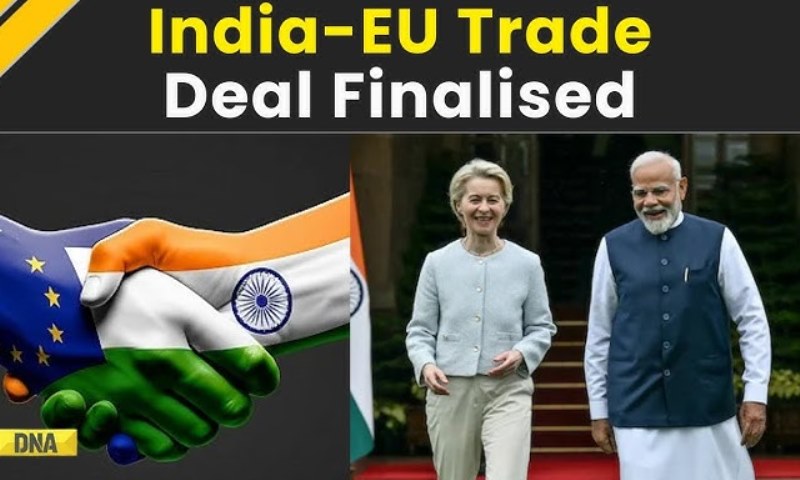
In a landmark development for global trade, India and the European Union today jointly announced the conclusion of the India–European Union Free Trade Agreement (India–EU FTA) at the 16th India–EU Summit, held during the visit of European leaders to India. The announcement was made by Hon’ble Prime Minister Shri Narendra Modi and European Commission President H.E. Ms. Ursula von der Leyen.
The agreement marks a historic milestone in India–EU economic relations, positioning the two as trusted partners committed to open markets, predictability, and inclusive growth. Negotiations for the FTA were re-launched in 2022, and today’s announcement reflects years of sustained dialogue, political will, and a shared vision for a modern, balanced, and rules-based trade partnership.
The European Union is among India’s largest trading partners. In 2024–25, bilateral trade in goods stood at INR 11.5 lakh crore (USD 136.54 billion), with Indian exports valued at INR 6.4 lakh crore (USD 75.85 billion) and imports at INR 5.1 lakh crore (USD 60.68 billion). Trade in services reached INR 7.2 lakh crore (USD 83.10 billion). Together, India and the EU represent the 4th and 2nd largest economies globally, accounting for nearly 25% of global GDP and one-third of global trade.
Union Minister for Commerce and Industry Shri Piyush Goyal hailed the agreement as a defining achievement in India’s global economic engagement. He said the FTA secures unprecedented market access for over 99% of Indian exports by value to the EU, strengthens the Make in India initiative, unlocks high-value services opportunities, and enables seamless mobility for skilled Indian professionals.
The FTA covers trade in goods and services, rules of origin, customs facilitation, trade remedies, digital trade, SMEs, and emerging sectors. It provides a significant boost to labour-intensive industries such as textiles, apparel, leather, footwear, marine products, gems and jewellery, handicrafts, engineering goods, and automobiles, eliminating tariffs of up to 10% on nearly USD 33 billion worth of exports upon entry into force.
A calibrated, quota-based liberalisation package for automobiles allows greater EU market entry in higher price segments while opening avenues for Make in India manufacturing and exports. Indian consumers are expected to benefit from advanced technologies and increased competition.
India’s agriculture and processed food sectors are set to gain enhanced competitiveness, particularly in products such as tea, coffee, spices, fruits, vegetables, and processed foods, while sensitive sectors like dairy and cereals remain safeguarded.
The agreement also addresses non-tariff barriers, strengthens regulatory cooperation, streamlines SPS and technical standards, and includes provisions related to the EU’s Carbon Border Adjustment Mechanism (CBAM) with assurances of flexibility, technical cooperation, and financial assistance.
In services, the FTA secures predictable access for Indian providers across 144 EU subsectors, including IT/ITeS, professional services, education, finance, tourism, and construction. The agreement also establishes a robust mobility framework, covering business visitors, intra-corporate transferees, contractual service suppliers, independent professionals, students, and practitioners of Indian traditional medicine.
The pact reinforces TRIPS-compliant intellectual property protections, recognises India’s Traditional Knowledge Digital Library (TKDL), and promotes cooperation in future-oriented areas such as artificial intelligence, clean technologies, and semiconductors.
The India–EU FTA is expected to significantly scale up trade, enhance export competitiveness, deepen value-chain integration, and strengthen strategic cooperation between India and the 27-member EU bloc. It becomes India’s 22nd FTA, and together with agreements with the UK and EFTA, effectively opens the entire European market to Indian businesses.
Aligned with the vision of “Viksit Bharat 2047,” the India–EU FTA sets the foundation for inclusive, resilient, and future-ready growth, reinforcing India’s role as a dynamic and trusted global economic partner.