
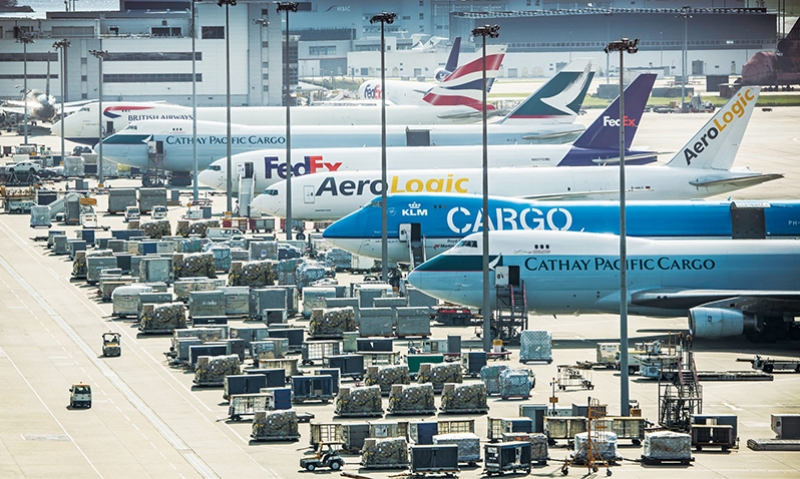
Hong Kong’s sea port may be in terminal decline, but its airport has topped the list of the cargo airport rankings again, while ecommerce triggered overall airfreight volume growth in 2024.
ACI’s latest provisional data on last year’s top airports puts Hong Kong firmly at the top again, with 14% more throughput last year than 2023, close to 5m tonnes, and a post-Covid recovery, with volumes up 2.7% on 2019.
Shanghai came second, up from third in 2023, with volumes up nearly 10%, beating competition from FedEx hub Memphis, which fell one place to third, with cargo volumes down more than 3% – and 13% down on 2019.
Overall, said ACI, global cargo volumes were up 8.4% in 2024 over 2023, and 3.9% up on 2019, with more than 124m tonnes flown last year.
The top 10 airports accounted for more than 25% of global volumes, while volumes at the top 10 rose 9.3%.
“The increase in cargo is attributed mainly to strong ecommerce demand, maritime shipping disruptions, and declines in jet fuel prices,” noted ACI.
UPS hub Louisville went up to fifth place from sixth, with 15% more volume, while Incheon dropped from fifth to sixth, despite a 7.4% volume rise. Anchorage, despite a 9.4% hike, stayed at fourth place, while Miami (up 9%), Doha (up 11.1%), and Taipei (up 7.5%) remained at seventh, eighth and tenth respectively.
Guangzhou made it into the top 10, at ninth, up from 11th last year. However, this year to date, Guangzhou has seen a near 4% drop in capacity, according to Rotate. Shanghai Pudong’s capacity is up 6.7% year on year, while Hong Kong, so far this year, has seen capacity to the Middle East rise 17%, but to the EU it’s down 15%, and to North America it’s down 5%. The airport’s new three runway system will allow it to double throughput to 10m tonnes.
Cathay Cargo director Tom Owen said Hong Kong’s positioning was an “outstanding achievement”.
“We won’t rest on our laurels, however, and our investments into our fleet, network, facilities, and digital capabilities reflect not only our commitment to, but also our confidence in, the long-term future of the Hong Kong international aviation and logistics hub.”
Both Hong Kong and its home carrier have invested significantly into the airport, since the challenging Covid years. Yesterday, Cathay announced its latest venture: the successful completion of a trial of autonomous electric tractor (AET) operations at its terminal.
It explained that the trial involved a fully autonomous electric tow-tractor pulling four cargo dollies into the Cathay Cargo terminal and driving itself to the correct cargo transfer gate for loading.
“After loading, the AET drove itself out of the terminal and successfully completed its journey across HKIA to the furthest cargo apron, the WCA, delivering the cargo ready to be loaded directly onto a Cathay Cargo flight.”
Cathay said it had a “precise docking” ability, automatically aligning for seamless ULD loading.
The project is a joint effort between Cathay Cargo Terminal, Airport Authority Hong Kong, and UISEE, one of China’s autonomous driving companies.
“This has been an important proof of concept, to show that AETs are capable of more advanced workflows than we have seen so far for cargo, reducing manual processes and significantly enhancing operational efficiency,” said Cathay Cargo Terminal chief operating officer Mark Watts.
“This also improves overall cargo flow at the world’s busiest cargo hub, and significantly reduces carbon emissions associated with traditional ground service equipment.”