
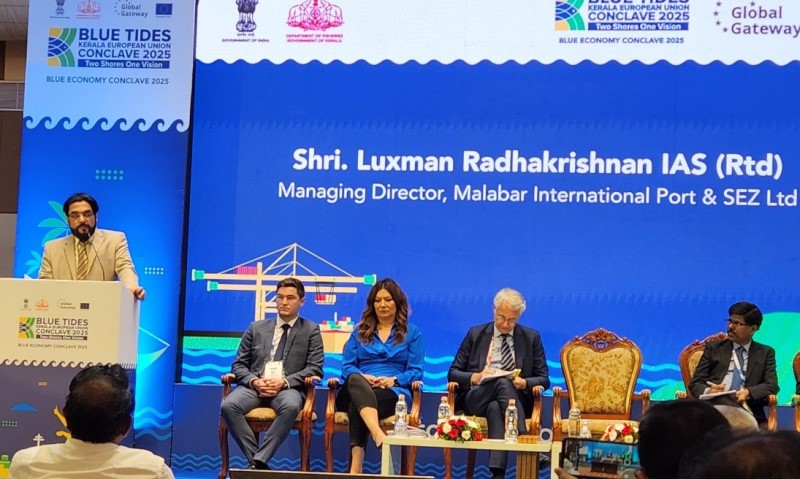
Kerala is poised to position itself as India’s smartest and most sustainable maritime state, capitalizing on the country’s ambitious plans for maritime development, experts highlighted during the Kerala-European Union Blue Economy Conclave, Blue Tides, held at Kovalam on Friday.
The panel discussion focused on harbour infrastructure, ports, logistics, shipping, and connectivity investments, emphasizing Kerala’s unique advantages in the maritime sector.
Foreign delegates expressed optimism about Kerala’s potential as India charts a new path in the Blue Economy. Finnish Ambassador to India, Kimmo Lahdevirta, who visited the Vizhinjam port on Thursday, praised the port’s rapid progress, noting its achievement in handling one million containers annually. “Vizhinjam Port, India’s only deep-sea port, is becoming a major player in the sector,” he said, adding that Finland could collaborate on advanced technologies such as 5G networks for harbour operations, similar to implementations by Nokia in his country.
Romanian Ambassador Sena Latif described her visit to Vizhinjam port as an eye-opener, impressed by the modern IT systems that reminded her of video game interfaces. She noted strong interest from Romanian companies experienced in sustainable port management, connectivity, and research ecosystems involving universities and port authorities.
Dr. A Kowsigan, Secretary of Ports, Government of Kerala, highlighted the significance of the visit by 19 ambassadors to Vizhinjam, underscoring the state’s growing capacity and improved rail and road connectivity. “By 2028, Vizhinjam port’s capacity is expected to reach 4.5 million TEUs, presenting vast opportunities for international investment,” he stated.
Luxman Radhakrishnan, Managing Director of Malabar International Port and Special Economic Zone, who chaired the session, emphasized Kerala’s historical maritime heritage as a foundation for expansion. He pointed out ongoing plans to develop ports in Beypore and establish special economic zones. Radhakrishnan called on domestic industries to develop proposals aligned with global regulations, including those of the European Union, to attract international investments.
Cochin Port Trust CEO Kasi Viswanathan outlined India’s ambitious maritime roadmap, noting that the parliament passed five bills last year to modernize the sector. Expansion plans include infrastructure development, shipbuilding, port digitalization, cruise tourism, and enhanced connectivity. “India currently has 12 major and 210 minor ports handling around 1,600 million metric tonnes of cargo, with total capacity near 2,600 million tonnes. This is expected to increase to 3,500 million tonnes by 2030 and reach an ambitious 10,000 million tonnes by 2047,” he explained.
Viswanathan also highlighted cruise tourism potential in Kochi, where designated areas are set for development, with tenders to be invited soon.
Antoine Canton, Strategic Projects Coordinator for shipping firm CMA CGM, said his company has been engaged in numerous projects over the last 30 years and is in discussions for further collaborations with Kochi port.
Organized by the Department of Fisheries, Government of Kerala, in collaboration with the Government of India and the European Union, the two-day Blue Tides conclave brought together EU envoys and other key stakeholders. The event marks a pioneering initiative in EU-India cooperation aimed at fostering sustainable and inclusive ocean-based development and economic growth.