
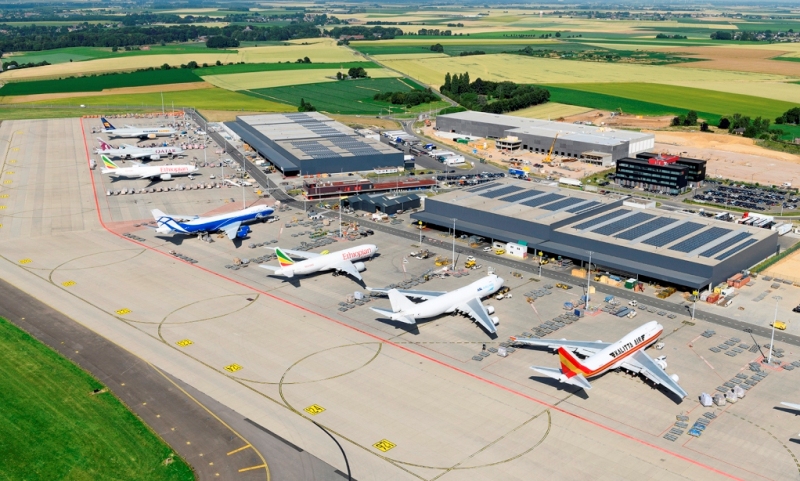
Funding and education are needed to help European airports improve perishables handling – but is the sector an attractive investment opportunity?
After capacity cuts at Schiphol Airport, flower shippers have looked to surrounding secondary hubs, like Maastricht, Liege, Ostend, Brussels, Frankfurt, Paris, to fly their product and then truck it to its destination.
Eline van den Berg, supply chain specialist at Royal Flora Holland, explained that this showed there was a lack of knowledge by ground handlers in how to handle these shipments.
“Ten years ago, let’s say 80% of the shipments went via Schiphol and it was a very efficient cluster who knew how to handle flowers – you have to keep them cool and handle fast,” she said.
“Something we realise now is that we’re receiving flowers from other airports and that knowledge is not there. You can’t blame them, but you must communicate.”
Owner & founder of Flowerwatch Jeroen van der Hulst added that most of these hubs “lack the facilities”.
“Ethiopia is quite good, facility-wise, facilities in Kenya are great. There are, maybe, 10-14 vacuum coolers around Nairobi Airport.
“Here in Europe, we are lagging behind…Why can we keep flowers fresh for weeks [at sea], and why can we see, in a 72-hour air transport, so much temperature abuse and so many boxes collapsing?”
Alain Tulpin, CEO of Tulpin Group, speaking at World Cargo Summit in Bruges this year, identified Liege as a particularly weak link for perishables shippers.
“Liege is by far the worst. They just put your stuff at 13, 14 degrees, strawberries don’t survive that. Then, in the supermarket, instead of a green, they get a yellow, an orange or even a red flag.
“Shippers massively say, ‘no, no, Liege, no’. Only when there’s no other place where they can land, do they accept the flight to Liege.”
But with significantly fewer restrictions and more lenient environmental and noise regulations than some European airports, plus 24/7 landing rights, Liege could emerge as the frontrunner to be the new perishables hub for Western Europe.
The airport said it received around 730 tonnes of flowers a day, 95% transported on to Aalsmeer, near Amsterdam.
“All freight forwarders have made heavy investment in Amsterdam (Aalsmeer) and think that due to the cost efficiency it would be best to transfer all goods as fast as possible.
“In a way, it makes a lot of sense, taking into consideration their assets, but the flowers heat during transport. That doesn’t mean the infrastructure isn’t good here, but investment made by all GHAs with flower corridors… will give other possibilities to the clients.
“Investments are being made,” it added.
Indeed, MD of Florius International Willum Van den Hoogen explained better facilities at the secondary airports would remove the need for an added trucking leg – which can expose flowers to unnecessary stress.
And according to Mr van der Hulst, “there is enormous opportunity coming for the first-movers to upgrade their cold room facilities”.
Mr van den Hoogen agreed: “I know we as an industry are sometimes very good at asking a lot and don’t pay for anything,” he admitted, “but that’s got to change. That mentality is going to change.”
Sam Quinteler, senior business and network development manager of cargo at Brussels Airport, said handling agents or airports could be looking to invest, but only in “something that is still relevant in five, 10, 15, 20 years, because these are huge investments”.
Mr Tulpin added that he was skeptical about flower shippers willing to pay a premium for quality infrastructure.
“The big problem in the flower business is they want the service and don’t want to pay for it.
“You have companies, they will land in Ostend, and we will say, ‘hey, we have a vacuum cooler here, it costs 4 cents a kilo’. They say ‘oh no, just put it in the trailer because it’s cheaper. Then you have your investment which doesn’t bring in any revenue.”
But Mr van den Hoogen assured: “There is also an important role for us growers, shippers, and importers. We need to communicate to the industry that we are willing to pay for a premium service and, where necessary, co-invest in it.
“This is something I actively advocate for and act upon accordingly. Those who add value in the chain should be rewarded and paid for their efforts.
“I’m aware this hasn’t always been the case, but in the end, it’s penny-wise and pound-foolish not to pay $0.04 extra for vacuum cooling on arrival, considering the risks of claims, the added costs of processing flowers in Aalsmeer into buckets, and/or the losses in value along the supply chain.”
He revealed that Florius was looking to invest in a vacuum cooler at Liege Airport, and Swissport is looking at expanding its flower corridor into Liege.
“These kinds of initiatives I very, very much admire, and I think really make a difference,” concluded Mr van den Hoogen.