
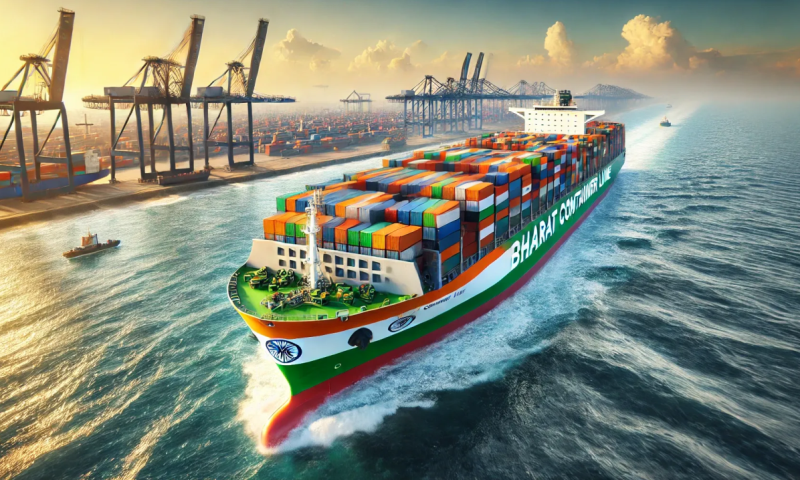
In a major push towards maritime self-reliance under the Atmanirbhar Bharat initiative, a consortium of state-owned entities led by Shipping Corporation of India (SCI) and Container Corporation of India (CONCOR) is set to float a new container shipping line, Bharat Container Line (BCL), aimed at reducing India’s heavy dependence on foreign carriers for export-import cargo.
SCI and CONCOR, both Navratna public sector companies, will each hold a 30 per cent stake in the proposed venture. Sagarmala Finance Corporation, the newly established non-banking financial company dedicated to the maritime sector, will take a 20 per cent stake. The remaining equity will be held by port authorities — Jawaharlal Nehru Port Authority (JNPA) with 10 per cent, while Chennai Port Authority and V O C Port Authority will hold 5 per cent each, according to sources familiar with the development.
The joint venture partners are expected to sign a memorandum of understanding in the coming days to take the plan forward. Stakeholders declined to comment ahead of an official announcement.
Three state-owned ports have been roped in as equity partners to help generate assured cargo volumes and strengthen the operational viability of the proposed container line.
India currently pays an estimated ₹6 lakh crore (about USD 75 billion) annually to foreign shipping companies as freight charges, almost equivalent to the country’s defence budget, resulting in a significant drain on foreign exchange. Government estimates show that only about 5 per cent of India’s EXIM cargo is carried on Indian-flagged ships, while nearly 99 per cent of the country’s containerised trade by volume is handled by foreign shipping lines such as MSC, CMA CGM, Maersk, Hapag-Lloyd, Evergreen, COSCO, ONE, and ZIM.
SCI, India’s only mainline container ship operator, currently owns just three container vessels, underscoring the scale of the challenge ahead.
The renewed push for a national container shipping line follows sustained lobbying by Indian exporters since the pandemic, which exposed vulnerabilities in global supply chains and sent freight rates to record highs amid equipment shortages. The situation has since worsened due to the Red Sea crisis, geopolitical tensions in the Middle East, and the latest tariff measures imposed by the United States.
Industry challenges ahead
Industry experts caution that Bharat Container Line will face stiff challenges in an industry dominated by large, privately owned global players. Unlike tramp shipping, container liner services require 8–9 vessels upfront to operate a viable weekly service on major routes such as India–Far East or India–Europe, industry sources said.
With global majors aggressively acquiring tonnage, second-hand container ships have become scarce and expensive. SCI itself has been scouting for used vessels for nearly two years without success, sources noted.
The government-owned nature of BCL could further complicate ship acquisition decisions, industry executives said, pointing to the need for swift, commercially driven decision-making.
Apart from vessel availability, berthing slots at container terminals, particularly on India’s west coast where capacity utilisation is already high, could pose another hurdle.
“Patriotism alone won’t sustain a liner service. The service quality, frequency, and commercial competitiveness have to match global standards,” an industry executive said, adding that BCL would have to clearly define what it offers exporters and importers that existing carriers do not.
Another executive said the new entity must be run in a purely commercial manner, warning that without careful planning and execution, the ambitious initiative risks becoming a “white elephant”.
Despite the challenges, industry stakeholders broadly support the intent, viewing Bharat Container Line as a strategic step towards strengthening India’s maritime sovereignty and reducing long-term dependence on foreign shipping lines.