
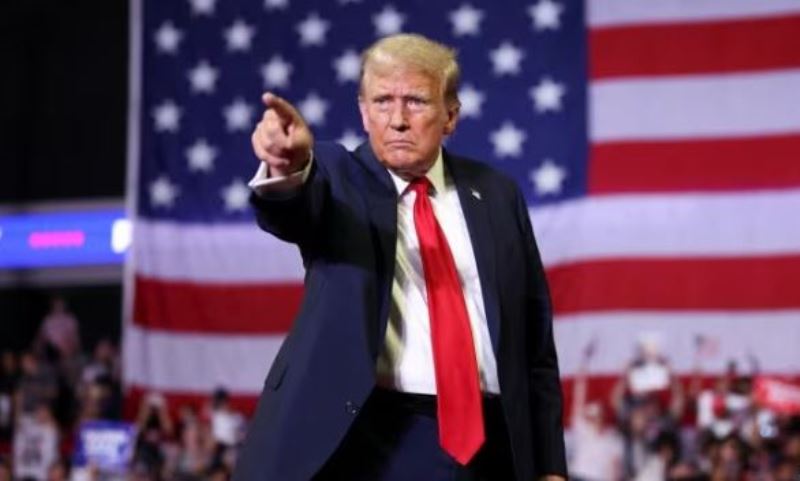
The United States (US) President Donald Trump on Monday (India time) said that Washington could raise tariffs on Indian imports if New Delhi does not stop buying Russian oil.
“They (India) wanted to make me happy, basically. Modi is a very good man; he is a good guy. He knew I was not happy, and it was important to make me happy. They do trade and we can raise tariffs on them very quickly. It would be very bad for them,” Trump told reporters aboard Air Force One.
Since August, the US has been imposing a 50 per cent tariff on several Indian imports. Of this, 25 per cent are linked directly to New Delhi’s purchase of Russian oil. Since last year, India and the US have been pursuing two parallel tracks—one is the broad bilateral trade agreement, which will take time to materialise, and the other is a framework trade deal that will address the burden of the 50 per cent tariff on Indian exporters.
Government officials in New Delhi said that a trade deal with India will be difficult to materialise if the US does not remove the 25 per cent punitive tariff. Talks between both countries have been going on for the last nine months, with no outcome in sight, despite over half a dozen rounds of in-person formal and informal negotiations.
Trump’s remarks came after US Senator Lindsey Graham, accompanying him on Air Force One, said that the tariffs imposed on India by Trump are the ‘chief reason’ New Delhi is now buying substantially less Russian oil. Graham said the US is pushing legislation to impose steep secondary tariffs on countries buying Russian oil and gas if Moscow fails to agree to a ceasefire in Ukraine within 50 days.
“…so if you want to end this conflict, then put pressure on Putin’s customers. We sanctioned the two largest oil companies in Russia, which is the biggest pressure anyone put on Putin since the war started…we put a 25 per cent tariff on India for buying Russian oil,” Graham said.
“I was at the Indian ambassador’s house about a month ago and all he wanted to talk about was how they’re buying less Russian oil. Would you tell the President to reduce tariffs? This stuff works,” he said.
Ajay Srivastava, former trade ministry official and founder of Delhi-based think tank Global Trade Research Initiative (GTRI), said after US sanctions in October on Rosneft and Lukoil, major refiners including Reliance Industries and several state-run firms said they would halt Russian oil purchases to avoid secondary sanctions. However, imports have not stopped entirely, with lower volumes continuing—leaving India in a strategic grey zone.
“This approach may be weakening India’s position. If New Delhi plans to stop Russian oil imports, it should do so clearly and decisively. If it intends to continue buying from non-sanctioned Russian suppliers, it must say so openly and support the stance with data. And if it plans to buy even from sanctioned entities, that choice too must be stated plainly. What no longer works is ambiguity. Complicating India’s calculus, there is no guarantee that cutting Russian oil will end US pressure. Even a full stop could shift the US demands to agriculture, dairy, digital trade, and data governance,” he said.