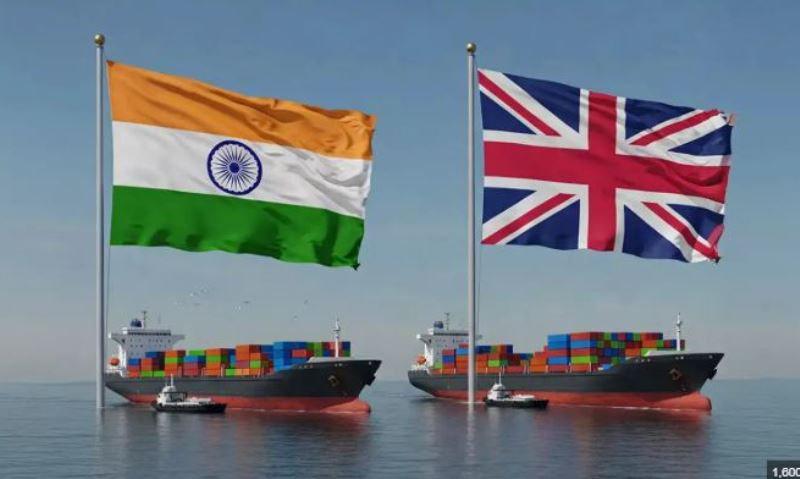
India and the UK on July 24, 2025, signed the Comprehensive Economic and Trade Agreement (CETA) in London, marking India’s 15th and one of its most wide-ranging trade pacts. The agreement, signed by Commerce Minister Piyush Goyal and UK Trade Secretary Jonathan Reynolds in the presence of Indian Prime Ministers Narendra Modi and his counterpart Keir Starmer, covers 26 areas, including tariffs, services, digital trade, intellectual property, and public procurement. It is expected to come into force within 6 to 12 months after approval by the British Parliament. The deal promises tariff elimination on a wide range of goods and unprecedented access to public procurement markets.
With sweeping tariff cuts, procurement access, and sector-specific benefits, the India‑UK CETA is poised to deepen economic ties and provide a significant boost to MSME-led exports, believe industry observers.
“Tariff concessions to reshape $23‑billion goods trade”
Ajay Srivastava, founder of the Global Trade Research Initiative (GTRI), highlighted the sweeping tariff concessions as a game-changer for bilateral trade worth $23 billion. “In FY25, India exported $14.5 billion worth of goods to the UK. Of this, $6.5 billion, or 45%, comprising textiles, footwear, carpets, automobiles, seafood, and fresh fruits like grapes and mangoes, will now enter duty-free, compared to earlier tariffs of 4-16%,” he said.
The remaining $8 billion of Indian exports—petroleum, pharmaceuticals, diamonds, and aircraft components—already enjoyed zero-duty access. The UK will now eliminate tariffs on all Indian goods except select agricultural items such as rice.
On the flip side, India will remove tariffs on 90% of UK exports, including immediate duty cuts for salmon, lamb, aircraft parts, machinery, and electronics. Items like chocolates, soft drinks, cosmetics, and auto parts will see phased reductions over 10 years.
A notable provision concerns Scotch whisky: duties will drop from 150% to 75% in the first year, ultimately reaching 40% by the tenth year. Cosmetics, perfumes, soaps, and medical devices from the UK will also see tariffs scrapped either immediately or in phases. Sensitive items such as apples, walnuts, and specific cheeses remain excluded from India’s tariff concessions.
Equally significant is India’s decision to open central government procurement to UK suppliers, covering 40,000 high-value contracts through the Central Public Procurement Portal (CPPP) and the Government e-Marketplace (GeM). “This access could set a precedent for future FTAs with larger economies like the EU or US, potentially eroding India’s leverage in using public procurement for domestic capacity-building and employment generation,”
Srivastava cautioned.
A transformative development for MSMEs
The Federation of Indian Micro and Small & Medium Enterprises (FISME), the largest MSME body, hailed the agreement as historic. “This is the first FTA with a large Western economy where Indian goods faced substantial price disadvantages due to tariffs,” said Anil Bhardwaj, Secretary General of FISME. He noted that labour-intensive sectors, such as marine products, leather footwear, textiles, processed foods, electrical machinery, chemicals, and jewellery—where duties ranged from 4% to 70%—will now gain zero-duty access. “The agreement also opens public procurement opportunities in both markets, allowing Indian MSMEs to participate in UK government tenders for the first time,” Bhardwaj added.
The country’s engineering sector also gave a thumbs up to the development. For India’s engineering exporters, the UK remains the sixth-largest destination, recording 11.7% growth in 2024-25. Yet, according to the Engineering Export Promotion Council of India (EEPC), Indian engineering exports to the UK stand at just $4.28 billion—less than 2.2% of the UK’s total engineering imports worth $193.52 billion. “This agreement unlocks vast untapped potential,” said Pankaj Chadda, Chairman of the Engineering Export Promotion Council of India (EEPC). “High growth segments like electric machinery, auto components, and industrial and construction equipment are projected to expand at 12-20% CAGR. EEPC estimates engineering exports to the UK could nearly double to $7.5 billion by 2029–30,” he said, highlighting 60% of EEPC members belong to the MSME ecosystem.
Similarly, the leather and footwear sector, one of India’s most labour-intensive industries, sees the CETA as a “winwin”. “The UK has always been a strategic market for Indian footwear. This FTA enhances competitiveness and creates opportunities for investment and employment,” said Puran Dawar, Regional Chairman of the Council for Leather Exports. Currently, India’s footwear industry is valued at $25 billion, with exports of $5.8 billion. The sector aims to grow to $50 billion by 2030—$14 billion in exports and $36 billion in domestic sales. Dawar added that the industry is broadening its product basket beyond leather to include sports shoes, sneakers, and safety and medical footwear and is inviting foreign direct investment from countries like Taiwan, and in these efforts, CETA will be a big
catalyst.
Electronics and home textiles: Competitive edge restored
Electronics manufacturers also welcomed the deal. “The UK-India trade agreement is a strong signal of trust in India’s electronics manufacturing capabilities,” said Abhishek Malik, Executive Director of Calcom Vision Ltd. “With duty-free access, Indian OEMs and EMS companies are better positioned to scale exports and expand globally.”
Additionally, the home textile sector, dominated by MSMEs, is equally upbeat. “Earlier, we faced an 8-10% duty disadvantage compared to Pakistan and Bangladesh. With tariffs gone, Indian exporters can regain market share,” said Vikas Singh Chauhan, Director of the Home Textile Exporters Welfare Association (HEWA). Leveraging the agreement, he projected a 10% rise in textile exports, particularly in bedding, linen, and décor, potentially adding 200,000-500,000 jobs over five years.
Anurag Sehgal, Principal, Price Waterhouse & Co LLP, further highlighted that with the extensive scope of the FTA, it is anticipated to play out interestingly for both countries. “It will be a game changer for Indian MSMEs, unlocking vast opportunities in textiles, leather, marine product, toys, gems and jewelry — currently a $941 million market poised to double in three years. Commitments on mutual recognition of professional qualifications and social security, and reduced barriers in financial and IT services will benefit comparatively smaller Indian firms to scale globally with ease. This agreement not only highlights India’s strategic prowess in forging comprehensive trade pacts amid global uncertainty but also serves as a blueprint for future deals, notably with the EU,” he said.
