
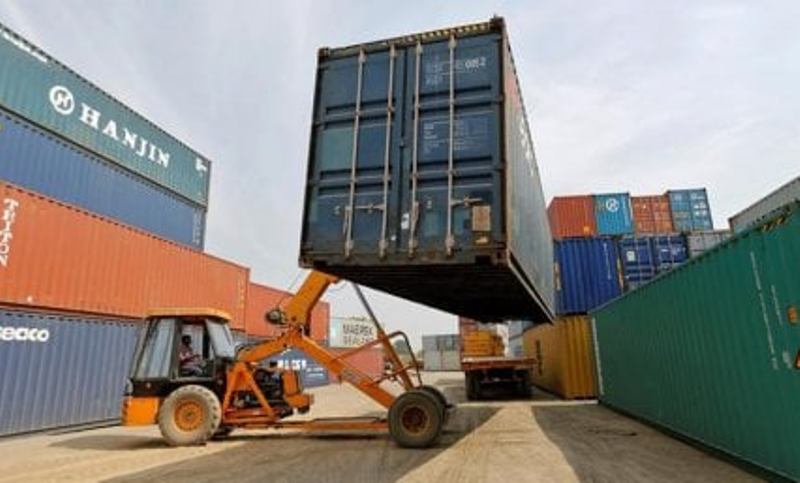
Container freight rates are expected to remain subdued for the rest of the current financial year, as global trade faces significant uncertainty stemming from US President Donald Trump’s erratic tariff policies.
Exporters rushed shipments to the US ahead of the August 27 deadline for a steep 50% tariff on Indian goods, aiming to cut costs. However, experts say the unpredictable trade environment is likely to weigh further on India’s exports—particularly to North America.
“We saw higher exports to the US with companies targeting the Christmas holiday season early,” said a shipping industry representative.
India’s exports to the US surged 18% year-on-year to $40.39 billion during April–August 2025, significantly outperforming the country’s overall export growth of just 2.5%, which stood at $184.13 billion. Meanwhile, China’s exports to India rose by over 10% to $51.57 billion during the same period, far exceeding India’s overall import growth of 2.14%.
Ajay Sahai, Director General and CEO of the Federation of Indian Export Organisations (FIEO), said sea freight rates could see a 10–15% correction due to excess shipping capacity and weakening global demand. “The US and European economies are clearly slowing. Persistent inflation and the risk of recession in advanced markets could deliver a serious blow to global trade,” he said.
The Drewry Container Forecaster supports this outlook, predicting a weakening of the supply-demand balance in the second half of 2025. This has already impacted spot container rates—Drewry’s World Container Index fell 6% this week to $1,913 per 40ft container, down from over $4,000 a year ago.
On the South East Asia–East Coast North America route, container freight rates dropped to $2,600 per 40ft container from $2,900 just 10 days ago—nearly half the $5,500 rate seen a year earlier. Logistics firms are already seeing mixed sectoral trends, as container lines begin to feel the strain.
Bhavik Mota, Director and Head of Markets (Intra Gulf & Far East, West & Central Asia) at AP Moller–Maersk, noted a sharp decline in automotive shipments, while shrimp exports are also vulnerable. “Rising prices for end-consumers due to Trump’s tariffs could further reduce demand,” he said. FMCG exports remain stable for now, but Mota warned this may change. Pharmaceutical exports, on the other hand, are holding strong and are expected to remain resilient.
Smaller Indian exporters are struggling the most, with some even canceling US-bound shipments amid the tariff uncertainty. A senior official at a shipping company said, “While large exporters are managing, smaller shippers are under pressure. About 20% of our volumes go to the US, and that segment is definitely facing challenges.”
Despite the gloom, there are some bright spots. Improved trade relations with China have led to an uptick in Indian imports ahead of the Diwali season. Reflecting this, Drewry’s Intra-Asia Container Index (IACI)—a weighted average of Asian spot container freight rates—rose 5% in the fortnight ending September 15, reaching $611 per 40ft container.
However, industry officials caution that unless the US eases tariffs on India and other countries, the long-term fallout will deepen. “End consumers will eventually bear these added costs,” one industry insider said.