
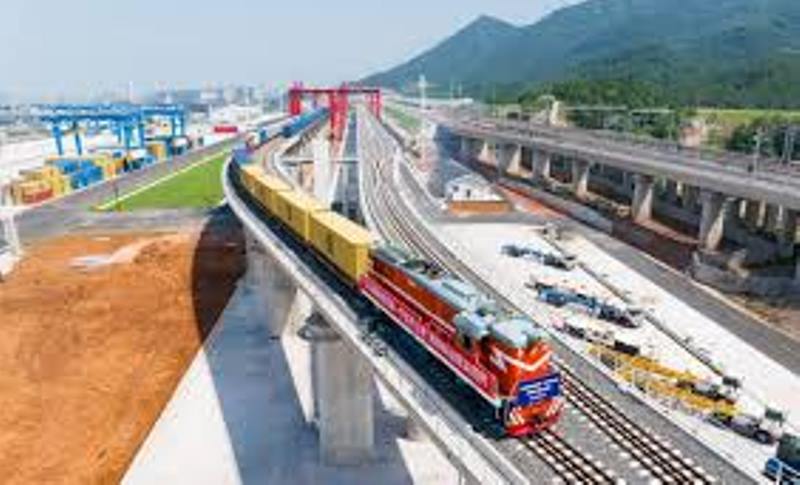
China has achieved another technological feat by linking multiple freight trains through a wireless system without mechanical hooks. The trial was carried out on Monday on the Baoshen Railway in Inner Mongolia when seven trains – each weighing 5,000 tonnes – ran on track together, dynamically managing the distance, as per a media report. This reduces the need to lay new train tracks and save money. The wireless system used to control the convoy of trains has been developed by China Shenhua Energy, a subsidiary of the state-owned mining and energy company CHN Energy.
The technology used by the Chinese company is very similar to the Advanced Driver-Assistance System or ADAS, popular in cars and is used along with adaptive cruise control that allows the vehicles to adjust speed dynamically.
In conventional railway operations, trains are required to run at a certain distance apart for safety reasons. For fast-moving (or express) and heavier trains, the distance is longer to allow proper braking. But the Chinese system of virtual coupling may allow the distance to be reduced due to the ability of trains to adjust braking according to changes in speed.
“Leveraging train-to-ground and train-to-train communication, the technology employs a two-dimensional control mode integrating relative speed and absolute distance, enabling dynamic close-formation operations.”
The new system would allow more freight trains to run without the need for new tracks. In the test-run, the freight trains had a combined cargo capacity of 35,000 tonnes and ran much more closely than the single units.
China has invested extensively in expanding the freight train network due to its safe, cheap and environment-friendly advantages. According to state-run newspaper China Daily, China has moved more than three billion tonnes of cargo in the first three quarters of this year.