
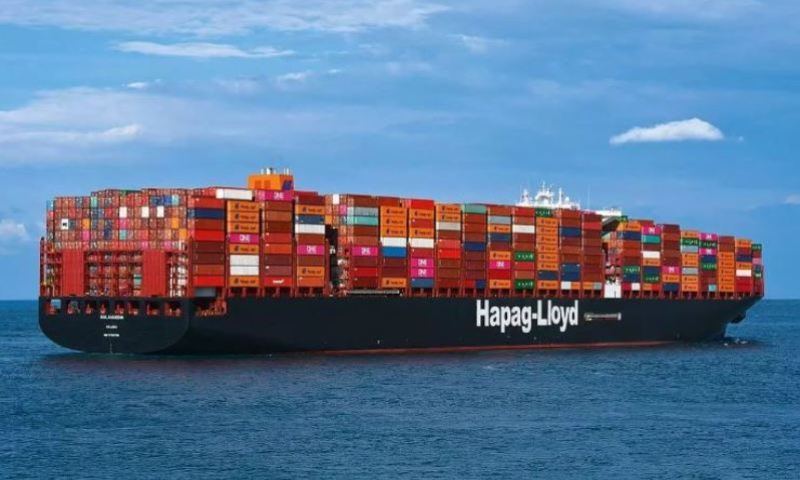
German container shipping major Hapag-Lloyd has firmed up its fleet renewal strategy with an order for eight dual-fuel methanol container ships at China’s CIMC Raffles, alongside long-term charter agreements for 14 additional vessels.
The eight newbuildings, each with a capacity of 4,500 teu, are scheduled for delivery in 2028 and 2029. Valued at more than $500m, the project marks Hapag-Lloyd’s first newbuild programme based on methanol propulsion. The vessels will be equipped with dual-fuel engines capable of operating on methanol as well as conventional marine fuels.
According to the Hamburg-based carrier, the ships will be up to 30% more efficient than older vessels in the same size segment and could reduce carbon emissions by as much as 350,000 tonnes of CO₂ equivalent annually when running on methanol.
The methanol order builds on Hapag-Lloyd’s growing alternative-fuel portfolio, which already includes 37 LNG dual-fuel ships in operation or on order, with the capability to use biomethane.
In parallel, Hapag-Lloyd has agreed to charter 14 feeder vessels on a long-term basis. These comprise four ships of 1,800 teu, six of 3,500 teu and four of 4,500 teu, with deliveries planned between 2027 and 2029. Together with the CIMC Raffles order, the carrier is investing in 22 vessels below 5,000 teu, in line with plans outlined earlier this year.
Chief executive Rolf Habben Jansen said fleet renewal is a cornerstone of the company’s Strategy 2030. “The new ships will help replace older tonnage, further decarbonise the Hapag-Lloyd fleet and reduce our dependence on the charter market,” he said, adding that operating costs are also expected to fall.
The methanol-fuelled newbuilds complement other decarbonisation initiatives by the carrier. Hapag-Lloyd has agreed with Seaspan to convert five 10,100 teu vessels to methanol dual-fuel capability in 2026 and 2027, and last year signed a supply agreement with China’s Goldwind for 250,000 tonnes of green methanol annually. The bio- and e-methanol mix is expected to cut greenhouse gas emissions by at least 70%.
Hapag-Lloyd is targeting a one-third reduction in absolute fleet emissions by 2030 compared with 2022 levels, and net-zero operations by 2045. As of the end of September, the carrier operated more than 300 ships with a total capacity of around 2.5m teu, ranking it as the world’s fifth-largest container line.