
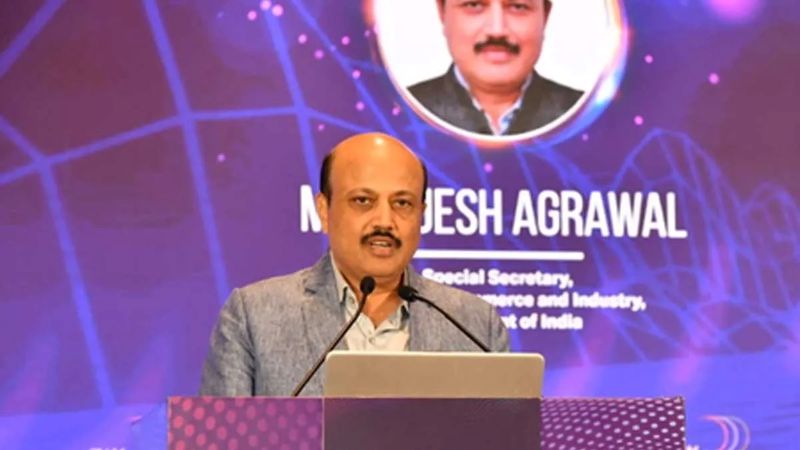
The Budget’s proposed conditional relaxation allowing Special Economic Zone (SEZ) units to sell goods in the domestic market is expected to promote import substitution and generate employment, Commerce Secretary Rajesh Agrawal said.
The government has announced a one-time measure permitting eligible SEZ manufacturing units to sell goods in the Domestic Tariff Area (DTA) at concessional import duty rates, subject to quantitative restrictions. Agrawal said the detailed framework for the proposal will be rolled out over the next two to three months.
Calling it a long-pending demand, the Commerce Secretary said SEZ units have been unable to sell excess production domestically due to global trade uncertainties and high import duties on labour-intensive sectors in India. “It will help in import substitution and better job creation. It will also provide a level playing field to DTA firms,” Agrawal told PTI.
He said the proposal would encourage sourcing from SEZs instead of importing goods from third countries. Around seven to eight sectors, including leather, textiles and engineering goods, are expected to benefit significantly, as these sectors currently attract high import duties.
At present, goods sold by SEZ units in the domestic market are treated as imports and attract full import duties, making them uncompetitive. In her Budget speech, Finance Minister Nirmala Sitharaman said the one-time measure aims to address capacity underutilisation in SEZ manufacturing units arising from global trade disruptions.
“The quantity of such sales will be limited to a prescribed proportion of their exports,” Sitharaman said, adding that necessary regulatory changes will be undertaken to operationalise the proposal while ensuring a level playing field for domestic units.
Agrawal explained that limits on domestic sales are essential to protect DTA industries. He noted that labour-intensive goods from countries such as Vietnam and Bangladesh currently enter India at concessional or zero duty under free trade agreements and preferential access. Vietnam is part of the ASEAN free trade agreement, while Bangladesh, as a least developed country, enjoys duty-free access.
“SEZs are treated as foreign territories. They can import raw materials duty-free, but production is meant for exports. If they sell in DTA, they must pay import duty, which makes sales unviable in high-duty sectors,” he said.
The Commerce Secretary added that trade dynamics have changed significantly since the SEZ law was enacted in 2005, with India signing multiple free trade agreements that already allow goods to enter the country at concessional duties.
He said sector-wise concessional duty rates and the permissible limit for domestic sales will be calculated and notified. “They cannot sell all of their production in the DTA. Only a portion will be allowed,” he said.
The move is also expected to help SEZ units mitigate the impact of steep tariffs imposed by the US on Indian goods, particularly in textiles and leather.
Exports from SEZs rose 7.37 per cent to USD 172.27 billion in 2024–25. India currently has 276 operational SEZs with 6,279 units across the country.