
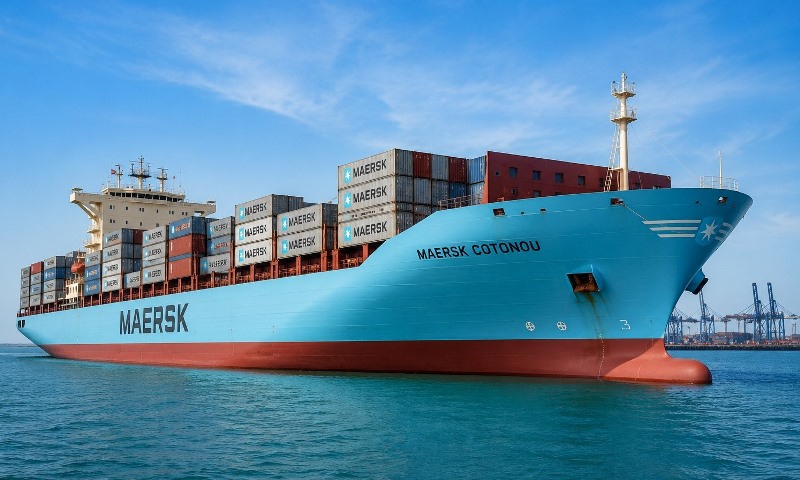
Danish shipping and logistics group Maersk has updated its booking requirements for vehicles transported in containers, introducing clearer classification, documentation and cargo-handling rules to improve safety and ensure compliance with international maritime regulations.
The updated guidelines, published on October 19, apply to new, used and damaged vehicles, including cars, motorcycles, e-bikes, e-scooters, boats, forklifts, golf carts and aircraft.
Under the revised requirements, shippers must select the appropriate commodity code based on the vehicle’s condition and declare the correct United Nations (UN) classification according to its power source. Lithium-ion battery-powered vehicles must be declared as dangerous goods under UN 3556, while lithium-metal battery-powered vehicles fall under UN 3557. Sodium-ion battery-powered vehicles are classified under UN 3558.
Petrol, diesel, gas-powered and hybrid vehicles generally fall under UN 3166, while other battery-powered vehicles may require UN 3171. Certain vehicles can qualify for non-dangerous goods treatment only if they meet all applicable conditions under Special Provision 961 of the International Maritime Dangerous Goods (IMDG) Code.
Maersk has also clarified the conditions under which vehicles will be accepted for shipment. Vehicles with damaged or defective batteries, flood or water damage, or signs of leakage will not be accepted. Loose or spare batteries packed alongside vehicles are also prohibited, although batteries installed in the vehicles are permitted.
All vehicles must be switched off, disconnected from chargers and free of active systems such as climate control or security modes. The auxiliary battery must be disconnected, with terminals and cable ends insulated to prevent short circuits. Vehicles must also be shipped empty, without additional goods stored inside, on or attached to them, apart from standard manufacturer equipment.
Proper cargo securing is another key requirement. Shippers are responsible for securing vehicles against movement in accordance with the IMO/ILO/UNECE Code of Practice for Packing of Cargo Transport Units.
Maersk recommends that battery-electric and plug-in hybrid vehicles be shipped with a battery state of charge of 30% or less. It also advises customers to use appropriate container placarding on all four sides to reduce the risk of delays at ports and transshipment terminals.
The company warned that bookings or containers that fail to meet the requirements may be rejected or held, with resulting costs charged to the shipper.
The updated rules reflect the growing complexity of transporting electric vehicles and other battery-powered cargo through global container networks. Correct classification and safe handling are increasingly important as international regulations evolve to address fire risks associated with lithium batteries.
For vehicle exporters, freight forwarders and logistics providers, the revised guidelines underline the need to verify cargo condition, power source, documentation and securing arrangements before submitting bookings to avoid disruptions and additional costs.