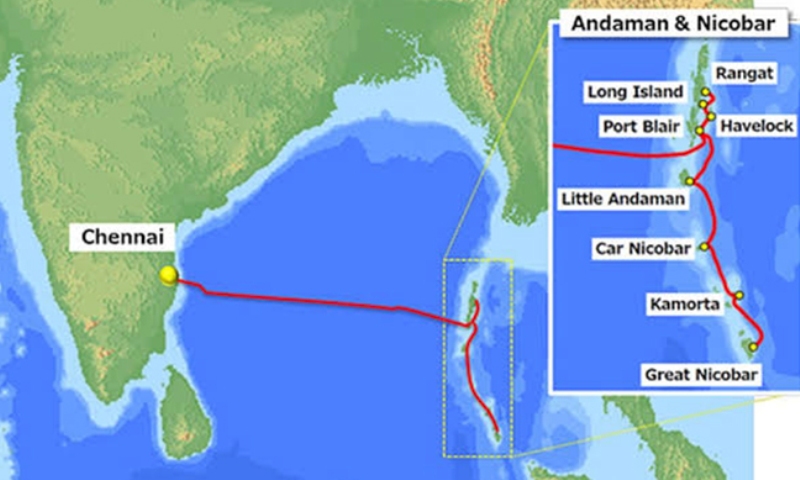
The proposed International Container Transshipment Port (ICTP) at Galathea Bay has moved a step closer to reality after the Public-Private Partnership Appraisal Committee (PPPAC) cleared the project structure, paving the way for Cabinet approval.
The mega port—planned with a total investment of ₹48,862 crore—will be developed in two phases through a joint venture (JV) in which an Indian-owned and controlled entity will hold a 55 per cent majority stake, while select state-owned major ports will collectively own the remaining 45 per cent. The move effectively keeps foreign operators out of the strategically significant project.
VGF to be funded outside standard scheme
The Ministry of Ports, Shipping and Waterways (MoPSW) has proposed viability gap funding (VGF) of ₹12,230 crore—equivalent to 25 per cent of the total project cost across both phases. However, the PPPAC ruled that the funding request falls outside the ambit of the Department of Economic Affairs’ (DEA) VGF scheme due to its scale and deviations from existing norms.
“The VGF scheme is not intended to provide large capital grants for mega projects,” the PPPAC noted, recommending that MoPSW fund the support through its own budget, subject to explicit Cabinet approval.
MoPSW justified the VGF requirement by pointing out that revenues for the project sponsoring authority are expected only from the 17th year, when financial break-even is achieved. The initial years, it said, will remain financially unviable due to high capital costs and project risks.
Strategic structure and risk mitigation
Kamarajar Port Ltd, the project sponsoring authority, will not hold equity in the JV—departing from earlier plans—to avoid conflict of interest in its dual role as sponsor and concessioning authority.
The project will be developed under a 50-year concession, with Phase I split into two sub-phases (IA and IB), each with a capacity of 2.8 million TEUs, taking Phase I capacity to 5.6 million TEUs. Phase II will add another 6.2 million TEUs, taking total capacity to 11.8 million TEUs.
To address construction and financial risks, including dredging uncertainties, both phases will be bid out together. The winning bidder will be selected based on the lowest VGF requirement.
The port will include 12 container berths, two POL berths, and one port craft berth. Phase II will also include a 3 million tonne POL facility.
Financial structure and investor appeal
The project will follow a 70:30 debt-equity ratio, which MoPSW said strikes a balance between financial viability and investor interest, given the scale and greenfield nature of the project.
The net worth requirement for bidders has been set at ₹3,850 crore, representing 55 per cent of the total ₹7,000 crore requirement for the JV.
To enhance viability, common infrastructure development—typically handled by the sponsoring authority—has been included within the JV’s scope. This is expected to give the private partner greater control over design, cost estimation, and execution, while ensuring long-term accountability.
Phase-linked viability strategy
The project has been structured to balance risks across phases. While Phase I involves heavy capital expenditure on core infrastructure, Phase II is expected to be the main revenue-generating stage.
MoPSW indicated that the concessionaire is likely to achieve financial break-even during Phase I, making Phase II essential for long-term returns. However, PPPAC advised incorporating flexibility in Phase II development obligations, along with contractual safeguards such as concession period adjustments in case of underperformance.
Describing the project as strategically important yet complex, the Ministry highlighted the inclusion of 45 per cent equity participation by major ports as a measure to retain government oversight and instill confidence among private investors.
Once approved by the Union Cabinet, the Galathea Bay transshipment port is expected to become a key node in India’s maritime strategy, enhancing its position in global container transshipment and reducing dependence on foreign hubs.
