
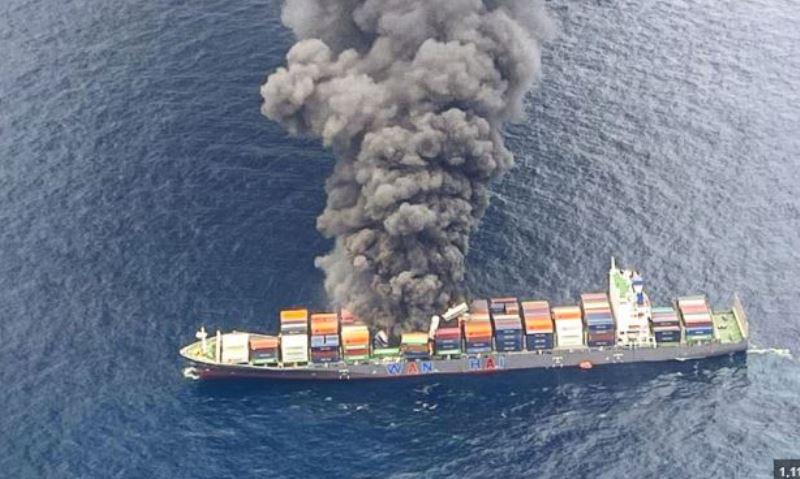
After more than three months of intensive salvage operations and nearly six months since the fire aboard the container vessel Wan Hai 503 was extinguished, Wan Hai Lines has confirmed the completion of cargo removal from the ship. While clean-up activities continue, the milestone marks significant progress in one of the most complex maritime casualty operations in recent years.
The vessel remains berthed at a designated Port of Refuge in Jebel Ali, United Arab Emirates. According to the company, only limited debris now remains inside the cargo holds, largely consisting of severely damaged and twisted containers that bore the brunt of the blaze. Due to extensive fire damage, identifying individual containers during discharge had become increasingly difficult.
In total, 1,696 containers were discharged from the vessel. The majority were fire-damaged, with only those stacks located near the stern—partially shielded by the deckhouse—escaping direct exposure to the flames. Salvage teams noted that container removal posed major challenges, as each unit had to be individually slung and hoisted onto dock storage areas for inspection due to structural instability.
While cargo discharge has been completed, removal of cargo residue and waste from cargo holds 3 and 4 remains ongoing. Wan Hai Lines stated that hold 4 will require additional time to clean due to the presence of a large volume of slurry. The salvage operation has also involved pumping approximately 11,675 tonnes of firefighting water from the vessel.
The fire broke out on June 9 while Wan Hai 503 was sailing in the Indian Ocean, about 54 nautical miles off India’s west coast. Indian authorities coordinated the evacuation of all 22 crewmembers on board. Four crew members—two from Taiwan and one each from Indonesia and Myanmar—were reported missing and are presumed to have died in the initial explosion and subsequent fire. Six other survivors were later hospitalized in India for medical treatment.
Indian authorities led prolonged firefighting efforts against the blaze, which ultimately consumed more than two-thirds of the vessel. Due to concerns over potential environmental damage, the ship was ordered to be towed farther offshore and was denied a port of refuge in India, triggering a prolonged search for a safe harbor. The vessel was eventually towed across the Indian Ocean to the UAE, arriving in September.
The incident has renewed discussions in India around the need to develop port-of-refuge capabilities for vessels in distress. In November, the Indian Coast Guard proposed that the state government in Paradip establish dedicated jetties capable of accommodating damaged vessels and recommended the deployment of larger coast guard vessels at every port in the state.
Authorities highlighted that Wan Hai 503 was not an isolated case. India has previously faced similar situations, including the X-Press Pearl incident, where a leaking container was denied refuge due to inadequate port capabilities. That vessel later caught fire, resulting in a major casualty despite being newly built. Officials also noted that enhanced refuge infrastructure would be critical not only for commercial shipping but also for protecting fishermen during emergencies such as typhoons.
The Wan Hai 503 incident continues to be viewed as a defining case in regional maritime safety and environmental preparedness discussions.