
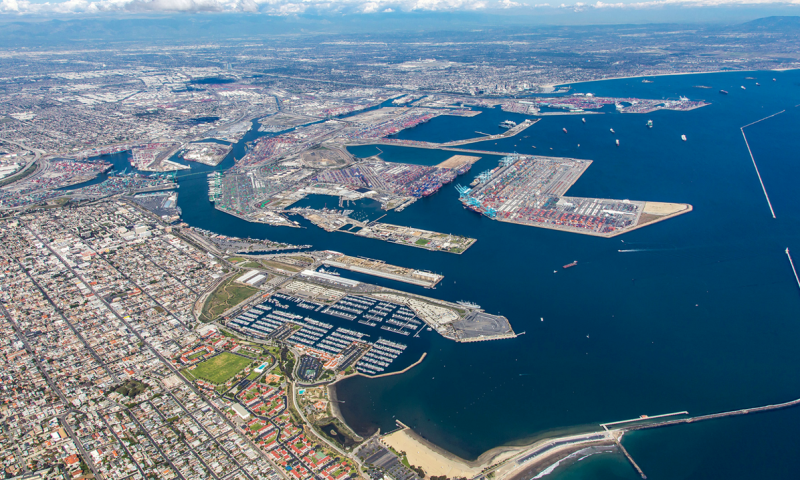
The nation’s busiest port complex experienced a decline in cargo volumes in September as shifting trade policies and rising tariffs disrupted consumer demand and altered shipping patterns across trans-Pacific trade lanes.
The Port of Long Beach handled 797,537 twenty-foot equivalent units (TEUs) last month, down 3.9% from September 2024. Imports fell 6.9% to 388,084 TEUs, while exports slipped 3.6% to 85,081 TEUs. Meanwhile, the neighboring Port of Los Angeles processed 883,053 TEUs, marking a 7.5% year-on-year decrease.
“Tariffs are impacting how consumers and business owners make financial decisions and purchases,” said Port of Long Beach CEO Mario Cordero. The port forecasts a relatively stable October, followed by a slight decline in November due to anticipated weather-related delays and vessel scheduling changes.
Port of Los Angeles Executive Director Gene Seroka highlighted the volatility affecting the maritime industry. “When sweeping changes were first announced, importers abruptly stopped their orders from China. When those policies were softened and deadlines extended, cargo volume picked up again. The supply chain has been on a roller coaster all year, and that ride continues,” Seroka said. He added that tariffs in one area often drive up prices in other segments, ultimately making goods more expensive.
Despite the September dip, both ports reported strong third-quarter results. Long Beach moved 2,643,614 TEUs between July and September, its second-busiest quarter on record. Los Angeles handled 2.9 million TEUs during the same period, the best three-month performance in its history.
For the first nine months of 2025, Long Beach has moved 7,390,245 TEUs, up 6.8% from the same period in 2024, while Los Angeles handled 7,817,057 TEUs, a 3% increase year-on-year.
Industry data suggest the slowdown is part of a broader trend. According to the National Retail Federation (NRF) and Hackett Associates, monthly import volumes at major U.S. container ports are expected to remain below 2 million TEUs for the rest of 2025. Retailers have largely frontloaded imports ahead of tariffs and are managing inventories to minimize cost impacts.
“This year’s peak season has come and gone, largely due to retailers frontloading imports ahead of reciprocal tariffs taking effect,” said NRF Vice President for Supply Chain and Customs Policy Jonathan Gold. “New sectoral tariffs continue to be announced, but most retailers are well-stocked for the holiday season and doing what they can to shield customers from tariff costs.”
Ben Hackett, founder of Hackett Associates, warned of continued uncertainty ahead. “Ongoing volatility in U.S. tariff policy is creating significant economic uncertainty, with trade volumes expected to see unpredictable shifts over the next four to six months,” he said. Industry forecasts project January 2026 volumes at 1.87 million TEUs, down 16.1% year-on-year, and February at 1.77 million TEUs, a 12.8% decline.