
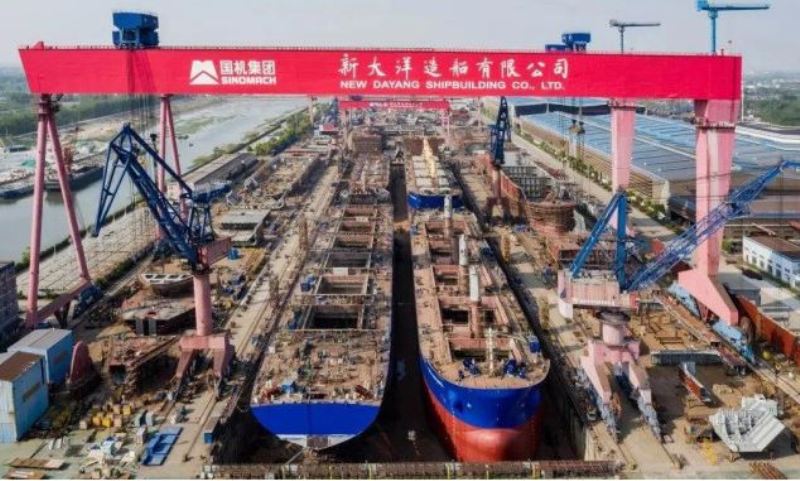
Broker BRS has provided an update on one of the main shipping themes of 2024 – China’s strengthening grip on the world’s shipbuilding output.
In terms of vessel delivery volume, newbuilding orders and orderbook, China’s market share accounted for 55%, 74.7% and 58.9%, respectively in the first half of this year, according to statistics from BRS.
According to BRS data, 11 Chinese shipyards have announced plans to increase their capacity. This should see their combined capacity increase by 80% from 2024 to 2027.
On top of this, some mothballed shipyards have been reopened across the nation in response to the shipbuilding market recovery and the surge in orders.
China’s growing dominance when it comes to ship construction is raising concern around the world.
Canada recently joined a growing chorus of shipyard nations taking aim at China.
Colin Cooke, president and CEO, Canadian Marine Industries and Shipbuilding Association (CMISA), delivered a hard-hitting message to Ottawa demanding that the Justin Trudeau administration enact tariffs against Chinese-built ships, following on from similar calls in the US and Europe.
Canada recently imposed a 100% surtax on Chinese-made electric vehicles, something CMISA would like to see extended to Chinese-built ships, which Cooke claimed in a release presents an even greater “strategic and ethical threat”.
“China’s shipbuilding industry operates under the doctrine of Civil-Military Fusion whereby commercial ship exports are subsidized to strengthen the country’s military capabilities,” Cooke maintained.
CMISA is calling for the imposition of a 100% surtax on all Chinese-built ships imported into Canada and demand a clear prohibition on any government entity from acquiring or leasing Chinese-built vessels.
“It is imperative that the government takes these steps to protect Canadian industries, uphold national security, and ensure that our economic policies are consistent with our commitment to human rights and ethical business practices,” Cooke wrote.
South of the border, the US Trade Representative (USTR) launched an investigation into China’s shipbuilding practices this April, with the Biden administration reacting to unions and bipartisan calls to clamp down on pricing policies for newbuilds constructed in the People’s Republic.
A Chinese Commerce Ministry spokesperson dismissed the shipbuilding probe when it was announced, telling reporters in Beijing: “It lacks factual basis and goes against economic common sense to blame China for America’s own industrial problems.”
European shipbuilders have also held a rallying call, determined to claw back business, urging politicians to come onboard.
SEA Europe, the association representing the European maritime technology industry, comprising shipyards and maritime equipment manufacturers, met with European members of parliament earlier this year in a call to action to European policymakers to formulate a comprehensive European maritime industrial strategy.
“Because of substantial price differentials of 30% to 40%, combined with advantageous financial incentives – especially offered by Chinese banks – European shipowners have increasingly opted for Asian shipbuilders,” a release from SEA Europe stated.
Shipbuilding capacity across the big three builder countries – China, South Korea and Japan – has grown by more than 20% over the past year, according to shipbroking estimates, with the majority of this capacity expansion in China and South Korea.
Nevertheless, the number of active shipyards around the world has declined by 55% from the peak reached in 2007.