
In the blink of an eye, India delivers around 102 parcels which adds up to over 8.8 million shipments a day, an astonishing rate only further fuelled by the explosive growth of the e-commerce industry and the rising expectation for same-day, next-day, and even 10-minute deliveries. The rush is only going to accelerate, with India’s e-commerce market estimated to grow five times to USD 300 billion by 2030, and third-party logistics players expected to sort as much as 17 billion.
Behind this surge is a logistics engine that runs commercial EVs across the crowded metropolitan streets to make last-mile deliveries. Long-distance electric trucks connect distribution centers that are far apart. Electric long-haul trucks connect far-flung distribution hubs. But when delivery becomes the norm, not the exception, it raises critical questions about long-term sustainability across the entire logistics chain.
Electrifying the Entire Supply Chain
The last-mile logistics garners the most attention, even though the bulk of inefficiencies and emissions lie deeper in the mid- and first-mile segments. These are the elements of the supply chain, connecting production hubs to storage and ultimately to consumers. This is worrying since India’s light commercial vehicles (LCVs) still don’t have to follow emission laws as passenger vehicles do.
Bridging this policy gap might significantly speed up the decarbonisation of commercial EV fleets. This is especially true because electrifying these fleets could have far-reaching implications on emissions and the environment. The path forward isn’t about moving more but about moving smarter, cleaner, and more sustainably.
The Sustainability Imperative
Indian cities, already congested with pollution and traffic congestion, are also experiencing a new environmental crisis. Delivery trucks idle at intersections, crawl through congested lanes, and haul heavy loads over vast urban landscapes.
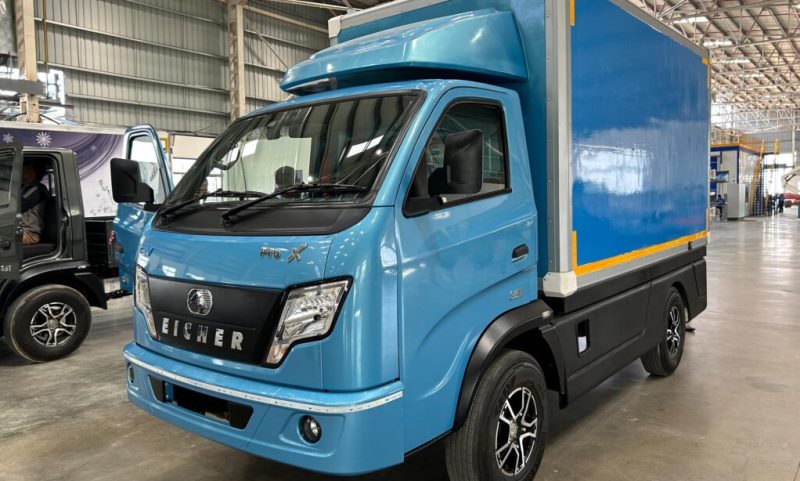
Here, electric light commercial vehicles (e-LCVs) are to be at the forefront of the decarbonisation drive for logistics. Several industry studies have shown that they can make a significant difference in total cost of ownership (TCO) and carbon footprint compared to traditional internal combustion engine vehicles, particularly in fleet operations with static routes and centralised charging points, offering operational benefits. With zero tailpipe emissions, reduced noise pollution, and a smaller carbon footprint, e-LCVs are the obvious choice for making India’s zero-emission vision a reality.
So why now? Because technology has finally matched ambition. New lithium-ion batteries with their dendrite resistance and temperature stability are best applicable to India’s diverse climatic conditions. Vehicular platforms, in turn, are also being adapted to Indian conditions by offering greater ground clearance, strong suspensions, and guard casings to sensitive components.
Utilisation Efficiency
Efficiency in logistics must be empirical, rugged, and ready for chaos. Indian roads pose challenges that traditional ICE vehicles barely withstand. E-LCVs are beginning to redefine what operational intelligence looks like, enabling double-shift operations. Thanks to fast-charging capabilities, vehicles can be topped up between delivery cycles and redeployed within hours. This significantly boosts vehicle utilisation and ROI. With the rise of fast commerce, dark stores, and 24/7 demand cycles, operational flexibility has become a necessity.
Projections suggest that by FY30, e-LCV sales could hit 236,000 units a year, capturing 14 per cent of the LCV and M&HCV market. This surge will be propelled by cost benefits and the operational edge that electric platforms now offer.
Smart Telematics and Predictive Logistics
Modern e-LCVs are loaded with digital elements as they come embedded with telematics systems that go beyond basic GPS to track vehicle health, monitor driving behavior, and generate predictive maintenance alerts. Intelligent systems within these vehicles now monitor and highlight factors such as overloading, harsh braking, and acceleration patterns . These are the crucial features for managing asset longevity and safety in chaotic urban and rural driving environments.
Tools like the “Easy Driver” algorithm allow fleet managers to track behavioral data, spot risky driving patterns, and deliver targeted driver training. This creates a feedback loop that allows for boosting safety, cutting maintenance costs, and extending vehicle life. In a sector where uptime drives revenue, this intelligence is becoming indispensable.
The Economic Advantage
While environmental concerns form the moral argument, the economic rationale for e-LCVs is equally compelling and perhaps even more urgent for logistics operators balancing tight margins.
With subsidies, e-LCVs show a 20 per cent lower TCO compared to ICE counterparts, saving fleet operators lakhs of rupees when scaled across hundreds or thousands of trips per month. Even without subsidies, the cost advantage remains at about 9 per cent. Maintenance costs, too, are significantly lower due to fewer moving parts, no oil changes, and reduced wear on brakes thanks to regenerative braking systems.
Today’s e-LCVs can charge up to 100 km of range in under 60 minutes and support home charging through 3.3 kW/6.6 kW onboard systems, ideal for off-peak replenishment. Fleet operations can now be planned around power tariffs, grid conditions, and route data.
e-LCVs at the Heart of India’s Logistics Transformation
India’s own commitment to a 2070 net-zero emission has brought the transport sector under sharp focus. Among the most impactful levers is the electrification of light commercial vehicles, which are central to the daily running of logistics across cities and towns. With proactive government support, the conditions for mass e-LCV adoption are steadily maturing.
After Bharat Stage VI norms took effect in FY21, diesel-powered LCVs began losing market share, dropping by about 25 per cent as gasoline and CNG options gained ground. By FY24, diesel still boasted 73 per cent sales, but the rise of CNG to 10 per cent signals a growing shift toward cleaner preferences.
Government policies have triggered this change exponentially. FAME-II offered incentives for buying up to Rs 2.1 lakh per vehicle, while a new scheme is in the works. The Production-Linked Incentive (PLI) scheme has encouraged local manufacturing of batteries and electric vehicle parts, and relief from customs duty on capital goods in the 2025 Union Budget will reduce input costs even more.
Collectively, these policies are reducing barriers to entry, thus upscaling infrastructure, and making e-LCVs the first choice for fleet electrification, enabling businesses to attain economic goals while moving towards sustainability targets.