
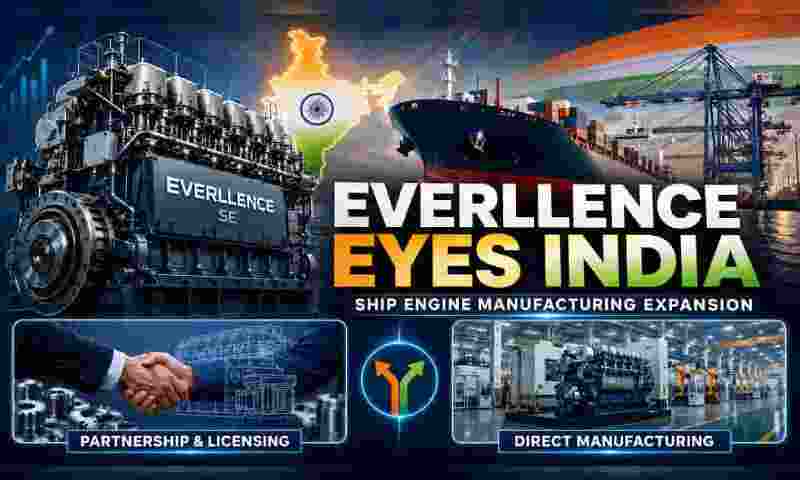
German marine engine manufacturer Everllence is in discussions with Indian companies to establish licensed production of two-stroke marine engines for large commercial vessels, marking a significant step toward expanding India’s shipbuilding and marine engineering capabilities. The company is also evaluating the possibility of manufacturing its high-speed four-stroke 175D engine in India through its own operations.
Everllence, the world’s largest manufacturer of marine engines, follows a global licensing model for its two-stroke engine business rather than producing the engines in-house. Under this model, local manufacturing partners produce the engines while the company provides technology, design support and receives royalties.
“We have plans for two-stroke engines in India. We don’t manufacture two-stroke engines ourselves; they are produced entirely by our licensees. We are now looking for one or two Indian partners to become our licensees for large commercial vessel engines,” Gaby Hanna, Managing Director and Senior Vice President, Head of Region Middle East & Africa at Everllence, said in an interview.
While declining to identify the prospective Indian partners, Hanna said the discussions involve established companies capable of supporting large-scale marine engine manufacturing. Globally, Everllence’s two-stroke engine technology is already licensed to leading manufacturers, including South Korea’s HD Hyundai Heavy Industries and Japan’s Mitsui E&S.
Two-stroke engines remain the preferred propulsion choice for large oceangoing merchant vessels due to their high power output, fuel efficiency, ability to operate on heavy fuel oil, and direct connection to the propeller shaft, eliminating the need for reduction gearing. The company has also been advancing dual-fuel and alternative-fuel engine technologies, including methanol, LNG and ammonia-compatible engines, to support shipping’s decarbonisation efforts.
The proposed licensing initiative aligns with India’s efforts to strengthen domestic shipbuilding and maritime manufacturing under its broader industrial development strategy. Local production of advanced marine propulsion systems could reduce import dependence, enhance technological capabilities and support the country’s ambition to emerge as a global shipbuilding hub.
Source: ET Infra