
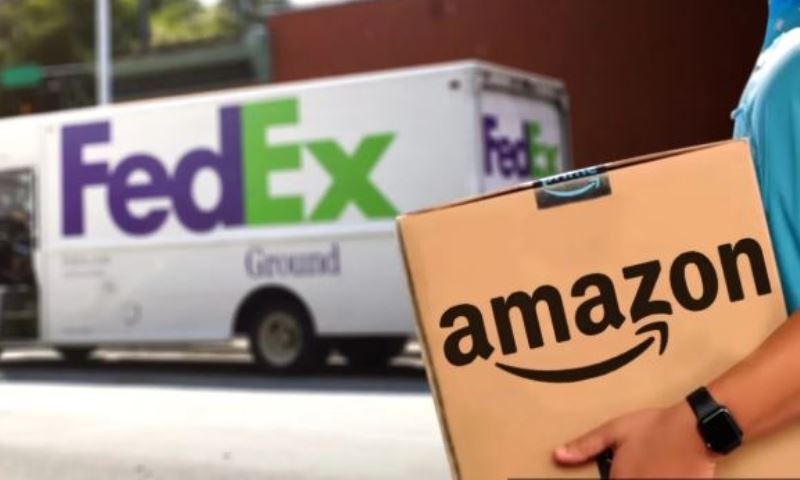
Six years after going their separate ways, FedEx and Amazon have hooked up again, to move large parcels.
Details are elusive, making it hard to see how deep the engagement goes, but it’s unlikely to result in a torrent of Amazon parcels into the integrator’s network. However, both sides should benefit from the reunion.
Under the multi-year agreement, FedEx will make residential deliveries of “select large packages” to Amazon customers, which does indicate a limited scope for the partnership, dealing with shipments that do not fit the parcel sorting systems used for the majority of e-commerce traffic.
But FedEx wasted no time in announcing the deal on its website to e-commerce shippers, extolling the benefits of its free Bulk Upload tool to import shipments from Amazon, and manage shipping from one place, as well as enhance their seller rating with the online platform.
Shares in FedEx rose 2% in the wake of the announcement.
According to one report, the agreement includes a pledge of “cost favourability” to Amazon, compared with using UPS.
The news comes weeks after UPS announced it was going to accelerate the reduction of Amazon traffic in its network. Back in January, UPS revealed it was planning to halve the number of packages carried for Amazon by the end of 2026, citing poor profit margins.
It gave observers a sense of déjà vu – in 2019, FedEx announced it was not continuing its ground and air delivery partnerships with Amazon for the same reason.
The latest twist has prompted one observer to ask in a LinkedIn post if UPS was missing an opportunity or if FedEx was ahead in network optimisation and had found a way to deliver outsize parcels at a lower price than UPS “and still make a profit”.
According to Amazon, the new FedEx agreement is not meant to replace UPS, which tallies with the focus of the deal on large parcels.
Amazon is not looking for a carrier that can shoulder a large chunk of its traffic. According to Bloomberg, more than two-thirds of its deliveries move within its own network – at costs the integrated express carriers cannot match. Another estimate sees as much as 87% of around 6bn parcels delivered by Amazon in the US last year go through the e-commerce behemoth’s network.
Most observers described the new deal as an arrangement that benefits both sides – filling gaps in Amazon’s delivery capacity while boosting volume and network utilisation for the integrator.
According to a recent study, by shipping research and consulting firm ShipMatrix, opportunities for the express carriers to boost volumes are getting thinner. It noted that they lost ground to retailers’ private fleets and alternative carriers last year. Carriers other than FedEx, UPS, USPS and Amazon Logistics delivered 2.3bn packages in the US in 2024, a 44% increase over 2023.
Walmart, having expanded its Spark driver platform, can now reach 93% of US households with same-day delivery, according to ShipMatrix. It predicts that the networks of Amazon, Walmart, Target and other large retailers will account for most of the volume growth in US parcel traffic in the coming three years, while UPS, FedEx and USPS face flat to negative growth.
Satish Jindel, founder and president of ShipMatrix and SJ Consulting Group, noted that the integrators had “caused mounting annoyance among shippers with an endless litany of rate hikes and increases in surcharges”.
Indeed, on Monday UPS announced a surcharge on shipments from the US to Canada for 18 May – four days before a possible strike at Canada Post.