
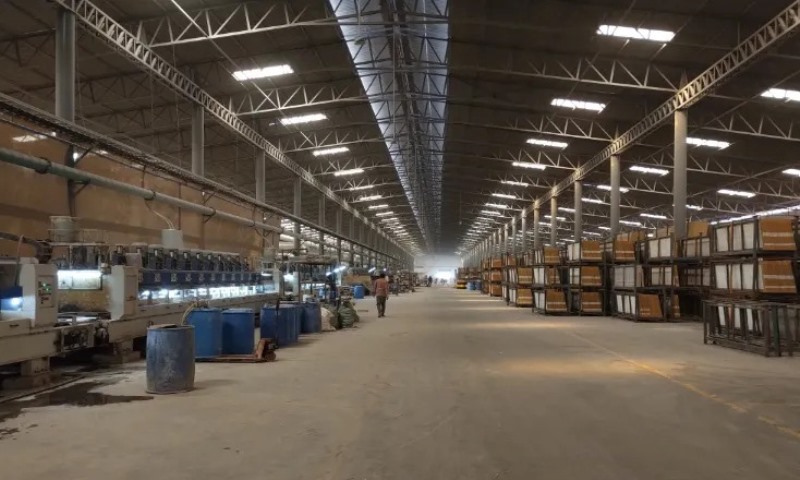
A significant milestone in India’s industrial and manufacturing landscape was marked with the launch of the Gujarat Industrial Development Corporation’s (GIDC) Integrated Ceramic Park at Jambudiya-Paneli. Spanning over 1,050 acres, the landmark project is set to transform the Morbi–Rajkot region into a world-class ceramic manufacturing hub, aligned with Prime Minister Narendra Modi’s vision of Viksit Gujarat leading to Viksit Bharat.
Positioned at the heart of India’s ceramic ecosystem, the Integrated Ceramic Park builds on the strength of the globally renowned Morbi ceramic cluster. The project is envisioned as a future-ready industrial zone that will strengthen Gujarat’s leadership in ceramics while enhancing India’s presence across the global value chain.
The park will primarily focus on the manufacture of tiles and sanitaryware, while also actively attracting investments in high-value niche segments such as industrial and advanced ceramics. By fostering innovation, technology adoption, and scale, the development is expected to significantly boost exports, employment, and industrial competitiveness.
Strategic Connectivity and Logistics Advantage
The Ceramic Park offers strong multimodal connectivity. Morbi railway station is located just 12 km away, while National Highway 27 (NH-27) lies within 1.5 km of the estate. The park is well connected to major logistics hubs, including Hirasar International Airport, Rajkot (70 km), and the Inland Container Depot (ICD) at Makansar (5 km). Export-oriented units can leverage proximity to key ports such as Navlakhi (48 km), Kandla (139 km), and Mundra (195 km), ensuring seamless domestic and international trade movement.
State-of-the-Art Infrastructure and Sustainability Focus
The Integrated Ceramic Park is being developed with a strong emphasis on infrastructure reliability, sustainability, and skill development. Planned facilities include a Common Display Centre, a Centre of Excellence equipped with a NABL-certified laboratory, and a Skill Development Centre aimed at nurturing innovation and enhancing workforce capabilities.
To meet industrial requirements, a robust 30 MLD water supply system will be implemented . Power infrastructure will include three substations—two of 66 KV capacity and one of 220 KV—ensuring uninterrupted and efficient electricity supply. Provisions have also been made for solid waste management systems and an in-estate Sewage Treatment Plant (STP), reinforcing the park’s commitment to environmentally responsible operations.
Catalyst for Industry, Investment, and Skills
Leveraging the abundant and skilled talent pool in and around Morbi, the Ceramic Park is expected to emerge as a benchmark for integrated industrial development in India. It will not only strengthen manufacturing capabilities but also act as a catalyst for technology adoption, quality enhancement, and skill upgradation across the ceramic sector.
The launch also aligns with the broader industry dialogue around ceramics, ports, logistics, and green energy. In this context, a dedicated conference focusing on these themes will be held in Rajkot on 11–12 January 2026, bringing together local businesses, industry leaders, policymakers, and investment partners.
With its scale, strategic location, and future-ready infrastructure, the GIDC Integrated Ceramic Park at Jambudiya-Paneli stands poised to redefine India’s ceramic manufacturing landscape and reinforce Gujarat’s position as a global industrial powerhouse.