
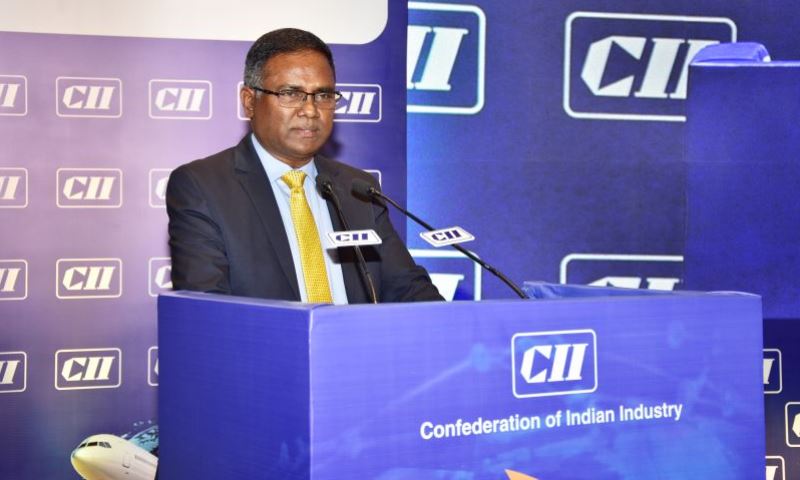
At the Confederation of Indian Industry (CII) Gujarat Logistics & Supply Chain Management Summit 2026, Upparapalli Venkat Rao, CEO & Director of Essar Bulk Terminal Salaya Limited, shared key insights on strengthening Gujarat’s position as a future-ready logistics hub.
Speaking on the evolving role of ports in India’s supply chain ecosystem, Rao emphasised that port efficiency today is no longer measured by speed alone, but by stability, predictability, and reliability of operations. He underlined the need for ports to transform into integrated logistics platforms rather than function as standalone infrastructure assets.
Rao highlighted that seamless coordination between ports, railways, road networks, logistics parks, and industrial clusters is critical to unlocking the next phase of logistics-led growth. Technology adoption and automation, he noted, are essential to scaling operations while ensuring safety, efficiency, and operational continuity.
Addressing the challenge of expansion, he stressed that scalability must be built into port design from the outset, enabling growth without disrupting ongoing operations. He further pointed out that safety and sustainability should be embedded by design, rather than treated as post-development add-ons.
Salaya Port was cited as a benchmark in this context, with Rao showcasing it as a fully mechanised and highly automated port delivering high productivity, robust safety standards, and environmentally responsible operations.
With manufacturing activity, energy transition projects, and EXIM volumes expected to rise, Rao concluded that the next phase of port-led growth in Gujarat will be driven by operational excellence, expansion readiness, and responsible scaling across the logistics value chain.