
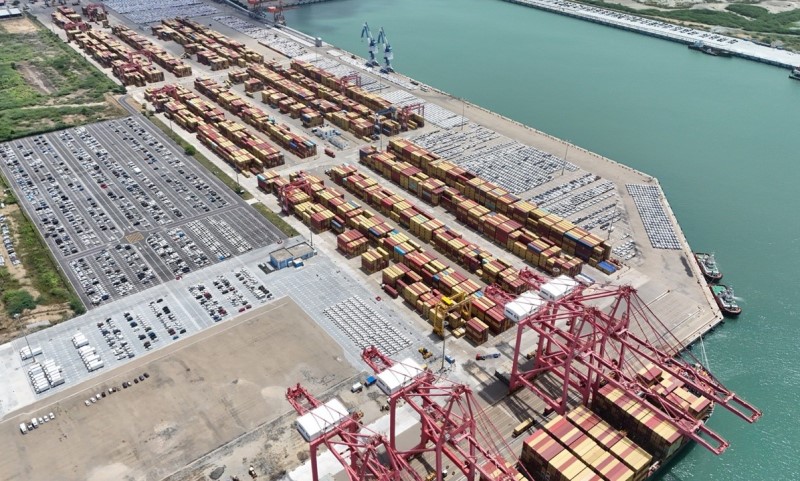
Sri Lanka’s China-backed Hambantota Port recorded a dramatic surge in container handling volumes in 2025, with throughput rising 705 percent to 428,036 twenty-foot equivalent units (TEUs), as the port moves to expand capacity to 2 million TEUs by the end of 2026.
Hambantota International Port Group (HIPG), a joint venture between the Sri Lanka Ports Authority and China Merchants Port Holdings, said the strong growth followed investments in new equipment and infrastructure after the port entered the container business in 2023, when it handled just 44 containers.
“Scheduled for completion by the end of 2026, the second phase will increase the port’s annual container handling capacity to approximately 2 million TEUs,” HIPG said in a statement. “This will be achieved by allocating four dedicated container berths and adding additional equipment, including six quay cranes and sixteen rubber-tyred gantry cranes.”
In 2024, the port invested 41 million US dollars in four new quay cranes and 13 rubber-tyred gantry cranes, adding to its existing fleet of two quay cranes and three RTGs, lifting installed capacity to around one million TEUs.
Container cargo handled at Hambantota amounted to 5.43 million tonnes in 2025, sharply up from 657,504 tonnes in 2024, which the port said underscored its “rapid emergence as a significant container gateway within a single year.”
Total cargo volumes at the port reached 8.24 million metric tonnes in 2025, a 175 percent increase from 3.0 million metric tonnes in 2024, driven by growth across container, roll-on roll-off (RORO), and bulk cargo segments.
Bulk and break-bulk volumes rose 32 percent to 1.18 million metric tonnes, while oil and gas volumes remained broadly stable at 661,131 metric tonnes amid softer global energy market conditions.
RORO vehicle volumes increased 25 percent to 726,153 units in 2025, as Hambantota continued to position itself as a regional vehicle transshipment hub. Sri Lanka also reopened vehicle imports in 2025 after a ban imposed in 2020 following macroeconomic instability.
“2025 was not an easy year to be a port,” said Wilson Qu, Chief Executive Officer of Hambantota International Port Group. “What makes this performance remarkable is not just the scale of growth, but that it was achieved amid sustained global disruption.”
“These volumes reflect customer confidence, operational flexibility, aggressive marketing strategies in Sri Lanka and internationally, as well as the commitment of our team,” he said.
Sri Lanka’s main Colombo Port, meanwhile, was targeting 8.2 million TEUs in 2025, supported by Red Sea shipping disruptions and the addition of a new terminal developed by India’s Adani Group in partnership with John Keells Holdings.