
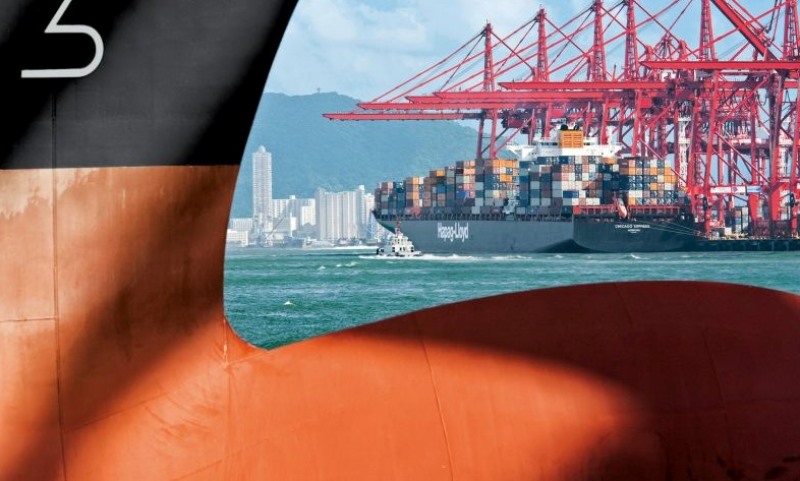
Hapag-Lloyd has signed a deal with Chinese shipbuilder CIMC Raffles for eight 4,500-TEU container vessels, with deliveries set for 2028 and 2029 and an investment exceeding $500 million.
The newbuilds will feature advanced dual-fuel methanol engines, offering up to 30 per cent greater efficiency than comparable older tonnage and the potential to cut as much as 350,000 tonnes of CO2e annually when operating on methanol.
The order marks Hapag-Lloyd’s first newbuild programme centred on methanol propulsion and adds to a growing fleet of dual-fuel vessels.
The carrier already operates or has committed to 37 LNG-capable ships that can also run on biomethane.
It has also moved ahead with retrofit and fuel-supply initiatives: five 10,100-TEU vessels are scheduled for conversion to dual-fuel methanol in 2026–27, and an agreement with Goldwind, signed in late 2024, will supply 250,000 tonnes of green methanol per year, with emissions reductions of at least 70 per cent.
Hapag-Lloyd further expanded its sub-5,000-TEU segment with 14 long-term chartered newbuildings—1,800 TEU (four units), 3,500 TEU (six units) and 4,500 TEU (four units) — to be delivered between 2027 and 2029, bringing its total investment in this size class to 22 ships.
Rolf Habben Jansen, CEO of Hapag-Lloyd AG, said: “Continuously modernising our fleet is firmly anchored in our Strategy 2030. The new ships will help replace older tonnage, further decarbonise the Hapag-Lloyd fleet, and reduce our dependence on the charter market. What’s more, operating these state-of-the-art ships will be much more cost-efficient.”
In November, a senior Hapag-Lloyd delegation visited the Sri Lanka Ports Authority (SLPA) to discussed closer cooperation and potential operational improvements.