
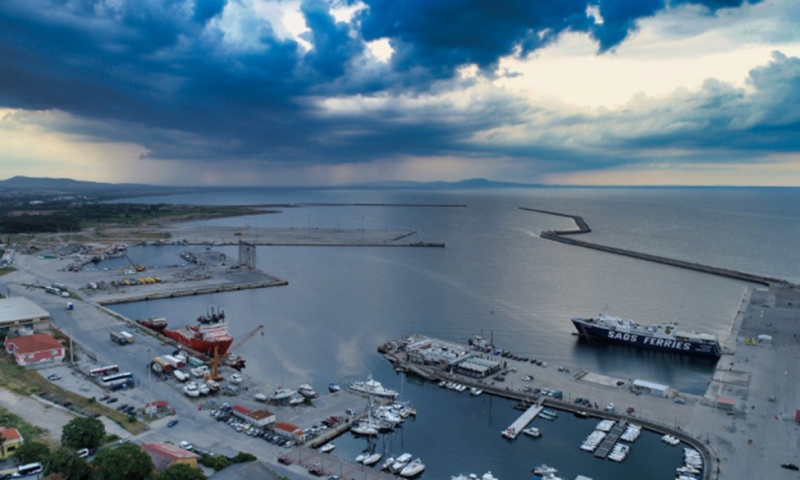
The Greek government is reportedly in talks with an Indian company for the potential acquisition of the strategically significant Port of Alexandroupoli—a move that could reshape not only Greece’s infrastructure landscape but also regional geopolitical dynamics.
The development was first disclosed by Fokion Karavias during the Delphi Economic Forum, with sources indicating that negotiations are centered on Alexandroupoli, a port that has evolved into a crucial hub for military logistics, energy transport, and trade flows into the Balkans, Eastern Europe, and the Black Sea region.
Since the onset of the Russia-Ukraine War, the port has gained prominence as part of alternative transport corridors, helping ease congestion and supporting supply chains, including those linked to food security.
The potential deal marks a shift from earlier policy. Prime Minister Kyriakos Mitsotakis had previously halted the privatization of the port, citing geopolitical sensitivities and the need for a broader strategic evaluation of such a critical asset.
India’s possible entry into Alexandroupoli introduces a new dimension. As a rising global power and a key player in initiatives like the India-Middle East-Europe Economic Corridor, India’s involvement could elevate the port’s role in transcontinental trade and connectivity.
The move also fits into a broader pattern of foreign involvement in Greek ports. The Port of Piraeus is controlled by China’s COSCO Shipping, while the Port of Thessaloniki is linked to businessman Ivan Savvidis. Meanwhile, the United States has shown interest in developing port infrastructure in Elefsina.
If the Alexandroupoli deal proceeds, it would mean that most of Greece’s key ports are influenced by major global powers, underscoring the country’s growing strategic importance at the crossroads of Europe, Asia, and the Middle East.
As negotiations continue, Alexandroupoli is emerging as a pivotal asset in a complex geopolitical chessboard, where economic interests intersect with national security and international alliances.