
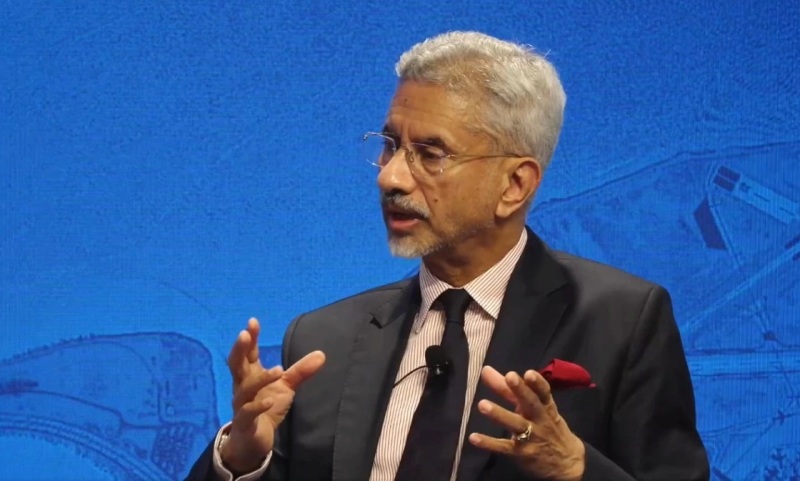
India has placed maritime security, the safety of seafarers, and the protection of global sea lanes at the centre of its campaign for a non-permanent seat on the United Nations Security Council (UNSC) for the 2028–29 term.
Launching India’s official campaign at the UN headquarters in New York on Monday, External Affairs Minister Dr. S. Jaishankar outlined New Delhi’s priorities under the theme “SHANTI – Securing Holistic Advancement through Norms, Trust and Integrity,” emphasizing the country’s commitment to maintaining a free, open and rules-based maritime order.
Addressing diplomats and UN representatives, Jaishankar said India would work to ensure that maritime security issues, including the safety of seafarers, piracy, humanitarian assistance and the uninterrupted flow of global trade, receive greater attention at the Security Council.
“In an era where supply chains connect our economies, the world is increasingly focused on securing the maritime commons,” Jaishankar said, stressing that adherence to the United Nations Convention on the Law of the Sea (UNCLOS) remains essential for maintaining safe and unimpeded maritime commerce.
He noted that India has consistently contributed to maritime security through anti-piracy, counter-narcotics and anti-trafficking operations across key shipping routes, including the northern and southern Arabian Sea, Gulf of Aden, Malacca Strait and the Gulf of Guinea.
The minister also highlighted the growing risks faced by seafarers amid recent geopolitical tensions in West Asia. Referring to developments in the Gulf, he said ensuring the safety of seafarers has become a major international concern.
India’s focus on maritime security comes at a time when disruptions in the Strait of Hormuz and attacks on commercial vessels during the recent West Asia conflict have affected global shipping, energy supplies and supply chains. Several merchant ships have come under attack, while Indian seafarers have been among those rescued during the crisis.
Jaishankar said India would continue promoting search and rescue operations, humanitarian assistance, disaster relief and maritime capacity building as part of its contributions to global maritime governance.
Apart from maritime security, India’s UNSC campaign will focus on six key priorities:
- Representing the voice of the Global South.
- Advancing reformed multilateralism.
- Building future-ready UN peacekeeping.
- Addressing emerging threats arising from the misuse of artificial intelligence.
- Securing the global maritime commons.
- Countering terror financing.
On terrorism, Jaishankar called for stronger international efforts to choke financial networks supporting terrorist organisations, stating that countering terror financing is essential for achieving lasting success against global terrorism.
India will also advocate objective and evidence-based mechanisms for listing terrorist organisations under the UN framework.
Highlighting India’s long-standing contribution to UN peacekeeping, Jaishankar said the country currently has around 4,300 personnel deployed across 10 of the 11 active UN peacekeeping missions, making it one of the world’s largest contributors to peacekeeping operations.
India will contest the election for the Asia-Pacific seat on the 15-member Security Council in June 2027, competing against Tajikistan for the 2028–29 term.
If elected, it will mark India’s ninth tenure as a non-permanent member of the UNSC, following previous terms in 1950–51, 1967–68, 1972–73, 1977–78, 1984–85, 1991–92, 2011–12 and 2021–22.