
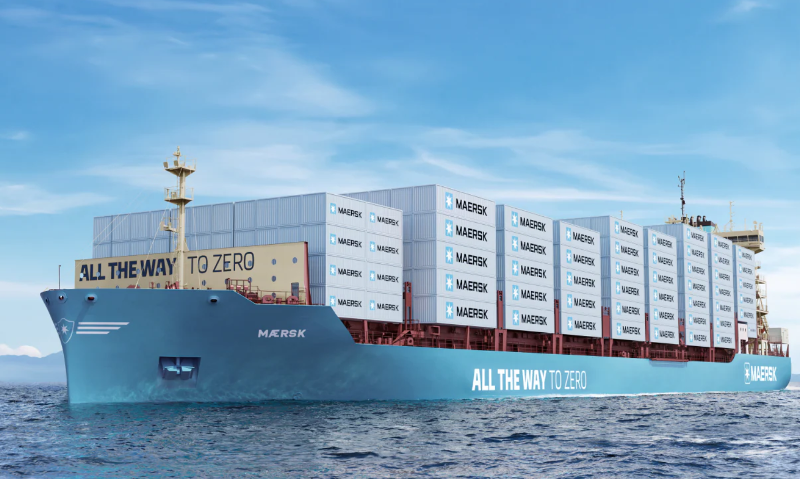
A.P. Moller-Maersk is moving ahead with its long-term fleet renewal strategy despite mounting pressure on freight rates and a reported fourth-quarter loss in its ocean shipping segment. The Danish shipping major has placed an order for eight 18,600 TEU dual-fuel container vessels at China’s New Times Shipbuilding.
Announced on 9 February, the order expands Maersk’s total orderbook to 33 vessels, with deliveries scheduled for 2029 and 2030. The timing positions the new ships to enter service just as the current wave of global newbuilding capacity is expected to peak, intensifying competition across major trade lanes.
Maersk’s decision underscores its continued focus on modernisation and decarbonisation, even as the container shipping market faces weakening freight rates and overcapacity concerns.
According to Anda Cristescu, Head of Chartering and Newbuilding at Maersk, the new vessels are designed to offer greater deployment flexibility compared to the largest ultra-large container vessels (ULCVs). Measuring 366 metres in length and 58.6 metres in breadth, the ships fall below the 24,000 TEU mega-ship category and can call at a broader range of ports.
Unlike the 400-metre vessels that dominate the main East–West trades, the 18,600 TEU series will be able to operate across more diversified service networks, providing Maersk with enhanced operational agility as trade patterns evolve.
The dual-fuel capability aligns with Maersk’s broader sustainability strategy, enabling the vessels to operate on alternative fuels as they become commercially viable. The company has been steadily building a pipeline of dual-fuel tonnage as part of its commitment to achieving net-zero greenhouse gas emissions by 2040.
The latest order signals Maersk’s confidence in long-term demand fundamentals and its intent to remain competitive in an increasingly complex and capacity-heavy market environment.