
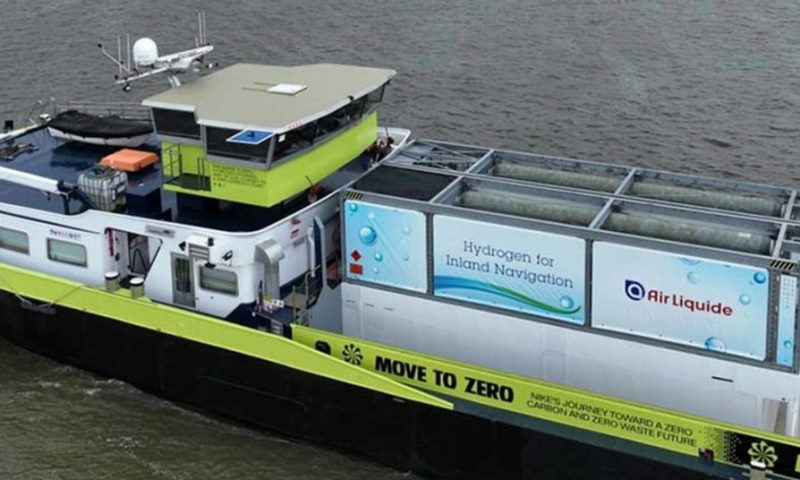
The Dutch Ministry of Infrastructure and Water Management is to establish safety requirements for the transport of hydrogen by inland waterway.
This includes refrigerated liquid hydrogen and ammonia as a hydrogen carrier, and the legal requirements necessary for safe transport will be identified in the coming period, as stated in the letter to Parliament on the Transport of Hazardous Substances, sent to the House of Representatives on November 3rd.
Refrigerated liquefied hydrogen can be transported via inland waterways, but this requires advanced ships and infrastructure due to the extreme cold of -253°C required to keep hydrogen liquid. Therefore, ammonia is preferred as a hydrogen carrier. Moreover, the cooling temperature for liquid transport is -33 degrees Celsius. Projects investigating hydrogen carriers (LOHCs) that are liquid at room temperature are still in their infancy.
Regulations regarding hydrogen transport still need to be developed, with a focus on safety. “Every train, truck, and inland vessel transporting hazardous materials must be safe,” the Ministry of Infrastructure and Water Management stated in the letter.
In the Netherlands, hazardous materials are primarily transported by inland waterway and rail. The Ministry aims to promote the transport of hazardous materials by water, specifically to reduce the inconvenience and impact on residents in the event of an emergency. Rail transport, which passes through densely populated inner cities, can be perceived as a nuisance, according to the Ministry. “In those locations, the consequences are also the greatest if an accident does occur. Therefore, the Ministry has investigated whether water transport can be promoted through inland waterway transport.”
The conclusion of this study, however, is that there are very limited options for this in the short term. “Shifting transport flows to other modes requires long-term investments and collaboration. This takes time, but the Ministry of Infrastructure and Water Management remains committed to this.”
According to the Ministry, adjustments to international safety requirements are being made based on the latest scientific and technical insights. The Ministry of Infrastructure and Water Management is commissioning a study into the effects of the unexpected release of ammonia and other hydrogen carriers during transport of this substance by road, rail, inland waterways, and pipelines.
The House of Representatives will be informed about the results of this investigation and any (international) follow-up steps around the summer of next year.