
Citing the last 100 days of maritime security operations undertaken by the Navy in the Arabian Sea under Operation Sankalp, Navy Chief Admiral R Hari Kumar Saturday said it has broken the myth of short and swift operations and underlined the need for sustained operations to ensure safety and stability in the ocean.
Addressing the media, he said no Indian-flagged vessels or vessels plying to Indian ports have been targeted by the Houthis at sea and piracy has resurfaced as an industry to profiteer from the disorder that is happening in that area due to the ongoing drone and missile attacks on merchant ships.
Since December last year, the Navy has increased the deployment of its warships and personnel in the regions covering Red Sea to the Gulf of Aden to the North Arabian Sea and to the East Coast of Somalia for anti-piracy, anti-hijacking and anti-drone operations.
“We are making sure that our assets are deployed in an optimal manner to ensure that it covers the area of interest and gives us the best information so that the maritime domain awareness and the requisite degree of transparency is achieved,” Admiral Kumar said.
As per the Navy, efforts made since December last year involved deployment of over 5,000 personnel at sea, over 450 ship days (with over 21 ships deployed) and 900 hours of flying by the maritime surveillance aircraft to address threats in the maritime domain.
Since November last year, there has been more than 90 maritime incidents, including 57 drone/missile attacks and 37 piracy/hijacking incidents.
Referring to the attacks launched by the Houthi rebels, Admiral Kumar said while there is no quarrel with them — since they haven’t targeted Indian-flagged ships — India has its ships deployed in the Red Sea region, which can protect its shipping when there is a need.
“We are escorting them now, essential cargo that is fertilizers, crude and finished products ,” he said.
“These are being escorted based on the request of our ministries… We had large number of ships that have been escorted, about 150 lakh tonnes of commodities have been escorted safely in the last 100 days. We will continue to do that and we will watch the situation,” he said.
Admiral Kumar said the ships at sea as well as people ashore in Yemen can identify ships passing by Bab-el-Mandeb with AIS receivers, radars and tracking network. Thus, only specific merchant vessels are being targeted by the Houthi rebels with missiles and drones, he said.
On the origin of drones and missiles, he said such drones can be manufactured locally by anyone.
“One of the drones that we recovered from one of the merchant ships had the capability to travel 1,600 kilometers,” he said, adding that it was made of plywood and basic material and had a four-stroke moped engine, very basic, elementary electronics, PCBs on board.
“You make a drone for say as cheap as less than Rs10-20 lakh and if you have to defend it and shoot it down, the missile will cost Rs5-10 crore. You see the asymmetry that has been brought in by using a low-cost weapon against a high-cost defending system,” he said.
About the origin of the missiles, he said the exact origin is not known as the Navy has not recovered any missile debris. “We do not know what is the origin and who made it. Probably we have been told that they get support from Iran, so it could have been from there,” he said.
Talking about increasing piracy incidents, he said it has led to the coming back of piracy High Risk Area (HRA) resulting in insurance rates getting elevated by almost 35 to 40 per cent and container costs going up to $2,000 from $500, with over 50% of the companies re-routing their ships around the Cape of Good Hope.
“What happens is the freight charges and insurance charges go up. Where is the effect going to be felt? It is going to be felt by you and me, people like us as consumers. The cost is going to get passed on to us.”
“We are thus taking proactive action to say that we will escort the ships and make sure that you are safe if you come through the Red Sea, and you know do your normal passage,” he said. “This is our effort to ensure that these sort of disturbances are put to rest and disorder does not prevail in the Indian Ocean Region.”
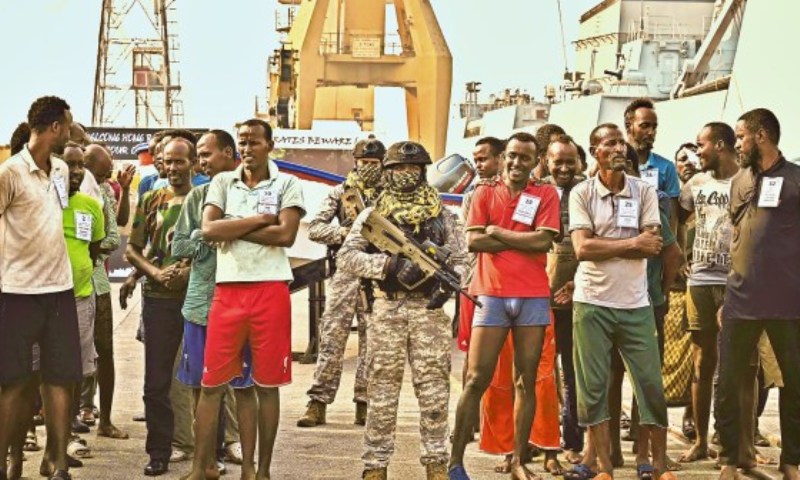
Elaborating on the ongoing anti-piracy efforts of the Navy, he said there are about 1,800 craft of all types from fishing vessels to merchant vessels and all. “Just to board one vessel and to inspect it thoroughly will take nothing less than 5-6 hours. So that is the type of effort that is required if you want to inspect a vessel and certify that it and not involved in illegal activities,” he said.
In a statement, the Navy said over 110 lives has been saved (including 45 Indian seafarers ), 15 lakh tons of critical commodities escorted (such as fertilisers, crude oil and finished products), nearly 1,000 boarding operations undertaken, more than 3000 kg of narcotics seized in the recent months.