
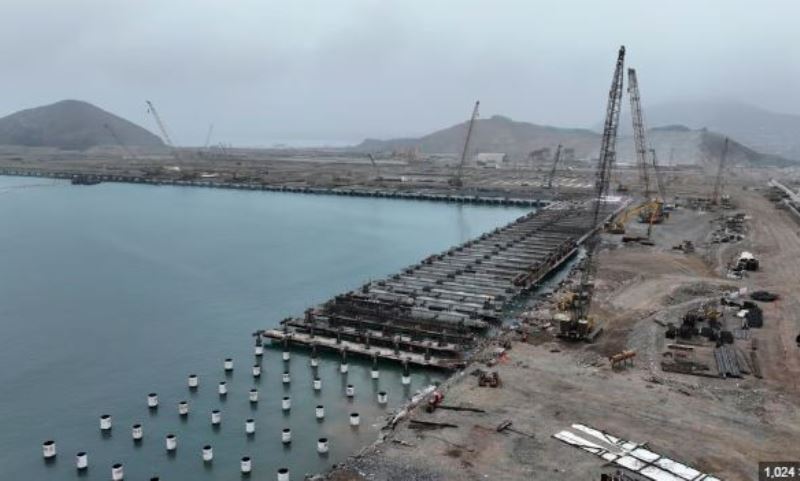
President Xi Jinping is expected to inaugurate Chancay port when he visits Peru next week. The Chinese-funded megaport may reshape Pacific trade, but has also made the United States uneasy. In the second of a two-part series, Igor Patrick looks at the implications for the whole of South American continent.
Erik Bethel, a former US representative at the World Bank during Donald Trump’s presidency, was speaking at a conference in Miami in May when he surprised the audience by interrupting his analysis of security in the Western Hemisphere to issue a warning.
“Wait until the port of Chancay in Peru gets connected to Brazil. That’s going to be a wake-up call for all of us,” Bethel said. “If you’re not tracking that, just Google it. It’s a big deal.”
While US policymakers have previously highlighted the potential security risks from the China-funded Chancay mega port – General Laura Richardson, commander of the US Southern Command, has been voicing concerns for years – Bethel’s statement stood out. It was one of the first warnings to emphasise the economic ramifications of the new port not just for Peru or Brazil, but for the entire South American continent.
Constructed at an estimated cost of US$3.5 billion, the mega port is poised to become a pivotal logistics hub in the region and a crucial connection point between South America and the Indo-Pacific.
Funded primarily through China’s Belt and Road Initiative, the project represents one of the most significant investments in Latin America under the Beijing trade-driven strategy.
With China strategically positioning this project as a potential triumph to offset recent belt and road setbacks in South America, the stakes are high. Chinese diplomats are actively promoting its prospects, and President Xi Jinping is expected to attend the port’s inauguration in November, underscoring its significance.
With the Chancay port, Beijing now faces the challenge of rebuilding trust and demonstrating the belt and road programme’s capacity to deliver reliable, high-quality projects that benefit host nations.
But government officials and experts in Latin America have concluded that the port’s scale far exceeds Peru’s current trade volume with China. In 2023, for example, Peruvian trade with China amounted to US$23.16 billion in exports and slightly over US$12.11 billion in imports.
These figures pale compared with Brazil’s economic ties with the Asian giant. In the same period, Brazil’s trade with China was nearly four times larger, with exports of US$104.32 billion and imports of US$53.17 billion.
Despite this significant advantage, Brazil lacks direct access to the Pacific Ocean, which may justify its interest in the Chancay port.
Brazilian officials recognise the port’s potential and are seeking ways to utilise it. Joao Villaverde, secretary for institutional coordination at the Brazilian Ministry of Planning, has met with representatives from all neighbouring countries to launch the South American Integration Routes project.
These routes, a key infrastructure initiative of President Luiz Inacio Lula da Silva’s government, aim to link Brazil with major South American trade and development hubs. Villaverde said two of the five planned routes will extend to Peru, with the port of Chancay playing a central role.
He was in Lima in March for talks with representatives of Peru’s Ministry of Transport and redesigned the route integration project after hearing suggestions from the Peruvians on how best to get Brazilian products to the port.
“This South American integration that we are planning has been designed taking into account the economic and structural changes of the last 24 years. In the past, we exported more to Argentina, the United States and Europe. That has changed; China is now our main partner,” Villaverde said.
“And as we get closer to the Pacific [through the port of Chancay], we also get closer to Asia and China in particular.”
Villaverde said that, if successful, “the routes could not only improve logistics for Brazilian farmers and mining companies that export to China”, but also create new economic hubs in the country.
He mentioned, for example, Brazil’s desire to not only mine lithium to supply the Chinese electric car chain, but to process the mineral and manufacture batteries before exporting them to China.
Brazil holds the world’s seventh-largest lithium reserves, estimated at 390,000 tonnes. A July report by consultancy A&M Infra said the country could increase its share of global production of this crucial mineral from 2 per cent to 25 per cent with strategic investments in exploration. Brazil also boasts rich deposits of cobalt and nickel, minerals vital for electric battery production.
Work is under way on the Brazilian side to speed up the integration routes and should be completed “by 2025 at the latest”, Villaverde said.
The topic was discussed at meetings of Brazilian officials in Beijing during the Sino-Brazilian High-Level Commission for Consultation and Cooperation summit in June. According to Villaverde, representatives of the Asian Infrastructure Investment Bank said they were open to discussing the financing of projects “connecting Brazil with the Pacific coast”.
Juan Carlos Paz Cardenas, president of the National Port Authority of Peru, said connection with Brazilian exports and supply chains could be “one of the keys to the success” of the project.
“[Cosco] assured me that they have already talked with their partners in Brazil and they are keen to take advantage of the opportunity of utilising Chancay as a port of departure for their cargo to China,” Cardenas said.
However, questions remain about the infrastructure needed to realise this plan. Cardenas conceded that right now, the route is “not ideal because running hundreds or thousands of lorries a year is expensive and it is not as logistically efficient as a railway”.
That opinion is shared by Leolino Dourado, a researcher affiliated with the Universidad del Pacifico who is analysing the port’s potential for Sino-Brazilian trade.
Dourado said that despite the optimism on the Peruvian and Brazilian sides about the potential new link between Brazil and the Pacific through Chancay, the long distances between the port and Brazil’s main agricultural regions will be a challenge.
The researcher explained that while Cosco and Peruvian government officials repeatedly emphasise that freight to Asia would be cut by more than 10 days for most goods, the difference is unlikely to play a role in the decision to use the port.
Using Manaus, one of the closest Brazilian state capitals to Peru, as an example, Dourado noted the stark difference in transportation distances and modes.
“From Manaus to Chancay, it’s about 3,600 kilometres, compared to roughly 1,000 kilometres to the nearest Atlantic port,” he said. “Moreover, the route to Atlantic ports benefits from river transportation, which is not currently available for the journey to Chancay.”
Dourado also said that while the Pacific route to China is approximately 5,000 kilometres (3,100 miles) shorter than the Atlantic, the economics of transportation don’t necessarily favour this option, since “shipping goods on the ocean is cheaper, a fraction of what it is on land”.
“The vast majority of the trade from Brazil with China is from [the states of] Minas Gerais and Para with mining. And then for soybeans, it’s Mato Grosso, Mato Grosso do Sul and Goias, all of them very far away from Peru.”
Dourado expressed concern about the high expectations and called for “a more measured approach” to what the project can achieve in a short term. He suggested that while the port has potential, a step-by-step evaluation of its benefits is necessary.
Cynthia Sanborn, director of the Centre for China and Asia-Pacific in Lima, is also sceptical about Chancay being used by Brazil or neighbouring countries any time soon. She said the port of Callao, near Lima, has existed for several decades and has never been considered a viable option for foreign exporters, mainly because roadways are unable to cope with the flow of lorries.
“If Callao is already a problem, the journey to Chancay takes at least three hours more, which is why we have to leave at 6:00am when we go there. Otherwise, there’s a lot of traffic. And see, railroads take seven years to build, so it’s not like [a solution] is coming tomorrow.”
“I think when Xi Jinping opens the port in person in November, he will probably be flown there. I can’t imagine him sitting in a motorcade for that long,” she joked.
Omar Narrea, a trade expert affiliated with the Centre for China and Asia-Pacific, offered a more optimistic view of Chancay’s potential while acknowledging the challenges.
Although acknowledging that it will be difficult to convince Brazilian exporters that Chancay is viable, Narrea said the port would meet commercial needs, not just for Peru but for neighbouring countries as well.
“It’s easy to say that Colombia, which does not have a competitive port to Asia, Ecuador and even Chile, will find a role in Chancay as a hub,” he said.
He pointed to the potential activation of economic corridors as a key factor in Chancay’s success. One such corridor would be through the interoceanic highway, a 2,600km road connecting Peru’s Pacific coast to Brazil’s Atlantic region.
Completed in 2011, the highway was planned as a transformative project for regional trade, but its impact has been limited. According to the Brazilian news website G1, on average only seven commercial vehicles use it per hour. The region is also beset by security challenges, as it has become a transit route for smuggling and drug trafficking.
Narrea said, however, that “what happened with the interoceanic is that it didn’t have a commercial meaning. It was more a political project.” He contrasted this with China’s approach to Chancay, which he describes as “really project-driven by marketing and business model.”
He said if Brazil and Peru “want to avoid the same mistakes, we will have to repurpose the interoceanic and create new corridors. And not 2,000- or 4,000-kilometre ones, but 1,500, which is more economically feasible.”
He emphasised the need to understand the economic activities along these routes, potential price changes, and how well-connected and competitive they are to the market.
In the meantime, the Peruvian government is reportedly trying to persuade the Chinese to supplement their investment in Chancay with additional funds for railway infrastructure.
A person who was in China with Peruvian President Dina Boluarte in July said the issue had been raised “in a series of high-level meetings with Chinese officials, private companies and development funds”.
The proposals put forward by the Peruvian government “had been favourably received, although feasibility studies still needed to be carried out”, the person said. According to Peru’s National Road Network, by 2038 the country will have an estimated US$44.3 billion in transport infrastructure gap.