
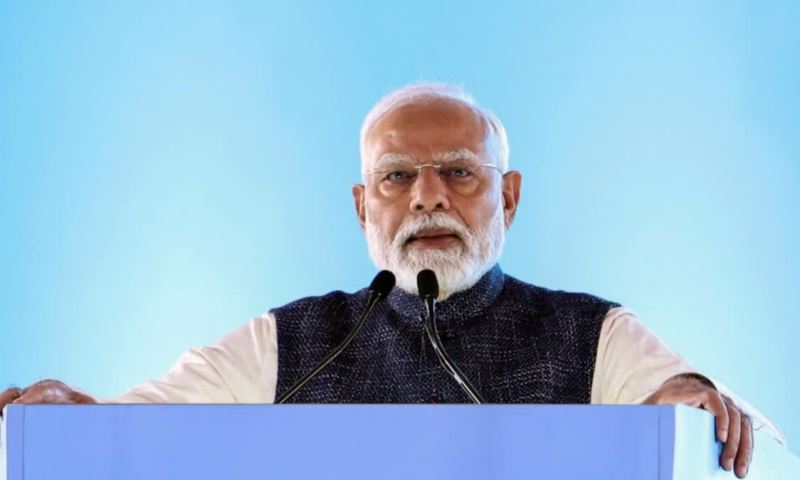
Prime Minister Narendra Modi on Monday laid the foundation stone for a new ammonia-urea fertiliser plant of the Assam Valley Fertilizer and Chemical Company Limited at Namrup in Assam’s Dibrugarh district, marking the start of a major brownfield expansion aimed at boosting fertiliser production in the North East.
The project will be set up within the existing premises of the Brahmaputra Valley Fertilizer Corporation Limited (BVFCL) and involves an estimated investment of over ₹10,600 crore. Once commissioned, the plant is expected to produce more than 12 lakh metric tonnes of fertiliser annually, catering primarily to demand in Assam and neighbouring states.
Addressing a gathering at the event, Modi said the new urea plant would help ensure an uninterrupted fertiliser supply to farmers while significantly reducing logistics costs through local production. “In the coming time, the new urea plant will guarantee a continuous supply of fertilisers,” he said.
Investment, output and jobs
The Prime Minister said the project would generate substantial employment, with direct jobs being created once the plant becomes operational, along with indirect opportunities in maintenance, supply chains and allied services.
He added that fertiliser production at Namrup would not be limited to Assam alone but would also support agriculture in Bihar, Jharkhand, West Bengal and eastern Uttar Pradesh. “With production taking place locally, supplies will be faster and logistics costs will be reduced,” Modi said.
According to him, the investment—close to ₹11,000 crore—forms part of a broader national effort to expand domestic fertiliser capacity and reduce dependence on imports.
Fertiliser self-reliance
Highlighting the government’s push for self-reliance in fertiliser production, Modi said India’s urea output has risen from about 225 lakh metric tonnes in 2014 to nearly 306 lakh metric tonnes at present, against an annual requirement of around 380 lakh metric tonnes.
He noted that the government bears the burden of high international prices through subsidies, allowing farmers to buy a bag of urea for around ₹300, even though the global cost is close to ₹3,000 per bag.
The Prime Minister also referred to the earlier decline of fertiliser units at Namrup, attributing shutdowns to outdated technology and prolonged neglect. He said the new project addresses those shortcomings and restores Namrup’s strategic importance as a key fertiliser production hub for the North East and eastern India.