
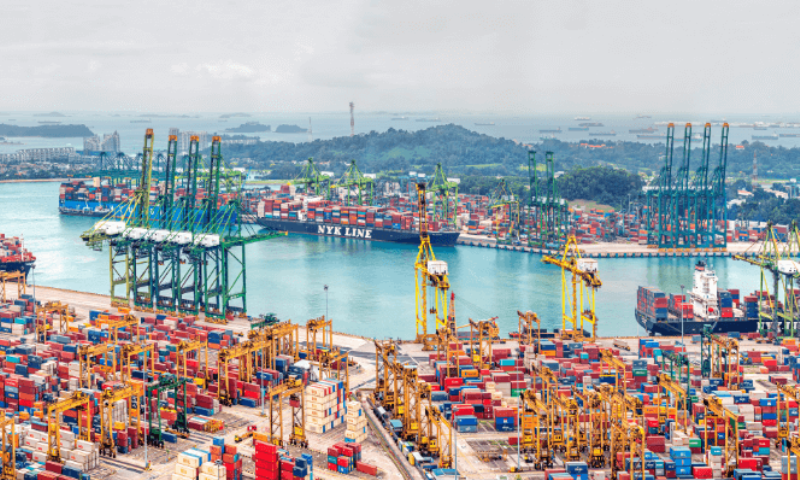
Singapore is investing further in its infrastructure, processes and workforce to solidify its position as a trusted regional cargo centre.
With more shippers expected to choose the city as their preferred transshipment and intermodal hub in 2025 and beyond, these investments aim to meet growing demand and strengthen Singapore’s global logistics leadership.
Officials from the Ministry of Transport (MOT) and Economic Development Board (EDB) said that efforts are being made to speed up the time taken for air-sea intermodal transshipments via Singapore in 2025, and incentivise leading logistics providers to expand their regional business activities and services provided here.
For example, a prototype app is being developed to equip shippers and logistics providers with functions to simplify and increase the efficiency of intermodal logistics in Singapore, an MOT spokesman said on Dec 20.
The functions include real-time flight or vessel data and status, bookings of flights or sailings, early alerts of delays, and cargo status visibility.
The move is being carried out under an Alliance for Action initiative to improve coordination between sea and air cargo, MOT’s spokesman said.
In March, Transport Minister Chee Hong Tat noted that the time taken for an air-sea intermodal transshipment via Singapore may exceed five days due to schedule uncertainties and manual processes carried out by smaller logistics providers.
He said his ministry’s aim is to halve that dwell time, and a “stretched target” to enable goods to depart Singapore on a connecting flight or vessel within 24 hours of arrival has been set.
Work is also under way to expand Singapore’s sea and air cargo handling capabilities through Tuas Port and the Changi Air Cargo Hub, as well as equip the workforce to adapt to advancements in the sector.
EDB vice-president Dave Goh noted that the Logistics Job Transformation Map, which will guide companies in training and reskilling their workforce, will be launched in 2025. By then, the sector could add 2 per cent, or $6.9 billion in annual value, to the economy and introduce 2,000 new jobs, he said.
Rising risk of shipping disruptions
These moves are being taken at a time when supply chains are increasingly gravitating towards South-east Asia due to escalating trade tensions between the United States and China.
The trend is expected to accelerate, as US President-elect Donald Trump has announced plans to raise tariffs on Chinese imports by as much as 60 per cent upon taking office on Jan 20.
As trade flows shift, “Singapore has the capacity and experience in transshipments to be able to facilitate this trend”, said Mr Peter Tirschwell, vice-president at S&P Global Market Intelligence.
Ports here are already handling record volumes of cargo. On Dec 24, port operator PSA said it handled an all-time record of over 40 million shipping containers, or twenty-foot equivalent units (TEUs), in 2024, up from 38.8 million TEUs in 2023.
But looming risks of disruptions to ocean shipping could add pressure on port capacity in the coming year.