
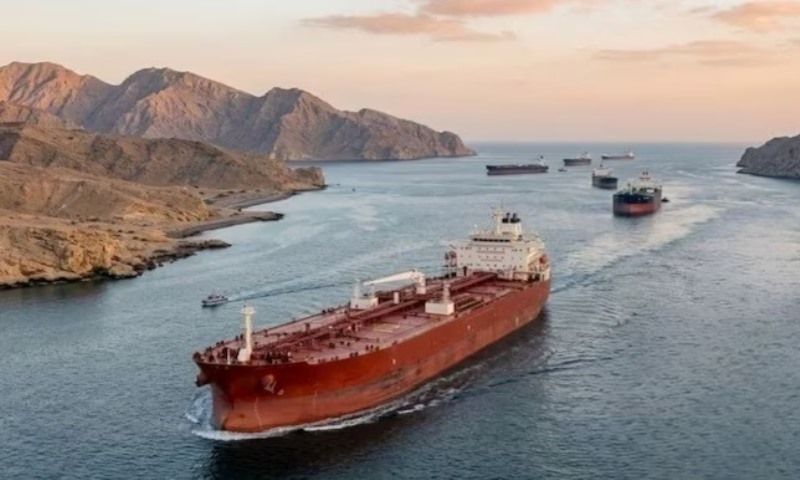
Maritime traffic through the Strait of Hormuz slowed significantly over the weekend after renewed exchanges of strikes between the United States and Iran prompted ship operators to avoid the southern transit corridor off Oman.
According to HFI Research, only four tankers and one container ship entered the Gulf via the Omani southern corridor on Sunday, escorted by US Navy vessels. Data from maritime intelligence firm Kpler showed that no vessels used the route to exit the Gulf on Sunday.
The slowdown followed an attack on a vessel transiting the strait on Saturday, just two days after another ship was targeted on Thursday. Although Washington and Tehran have since agreed to halt hostilities under a preliminary deal, shipping activity through the strategic waterway remains below normal levels.
By 1500 GMT on Monday, Kpler recorded only one vessel entering and one vessel leaving the Gulf via the Omani corridor. On Sunday, Iran also warned ships against using transit routes that had not been approved by Iranian authorities.
Overall vessel movements declined sharply over the weekend. Kpler recorded 29 commodity vessel transits on Saturday and only 12 on Sunday, while AXSMarine reported 36 crossings on Saturday and 19 on Sunday. Despite the decline, commercial traffic continues through the strait, although at reduced levels compared to last week’s wartime activity following the June 17 memorandum of understanding between Tehran and Washington.
Following Saturday’s attack, vessels continued using the southern Omani route for several hours before traffic diminished, according to MarineTraffic. However, the platform tracks only vessels with active AIS transponders, meaning additional ships may have crossed with their tracking systems switched off.
AXSMarine reported that 44 vessels stopped transmitting AIS signals in the Gulf region after Thursday’s attack. However, analyst Mihail Todorov cautioned that extensive AIS signal interference and spoofing in the region make it difficult to determine whether every case was directly linked to the recent attacks.
Meanwhile, shipping has continued along Iranian-approved routes. A CMA CGM container vessel exited the Gulf on Sunday via Iranian waters north of Larak Island, while Kpler data showed six commodity vessels using the Iranian route by Monday.
Since Saturday, inbound vessel traffic has exceeded outbound movements, reversing the trend seen over the previous week when shipping companies focused on evacuating seafarers stranded in the Gulf.
“Inbound traffic has remained relatively stable. The decline is almost entirely in outbound traffic,” AXSMarine analyst Mihail Todorov said.
The deteriorating security situation also forced the suspension of a United Nations-led operation to evacuate approximately 11,000 seafarers on Thursday after a vessel was struck in the Gulf of Oman.
Maritime analysts noted that total transit figures could be revised upward as additional vessel movements are identified retrospectively through satellite imagery.