
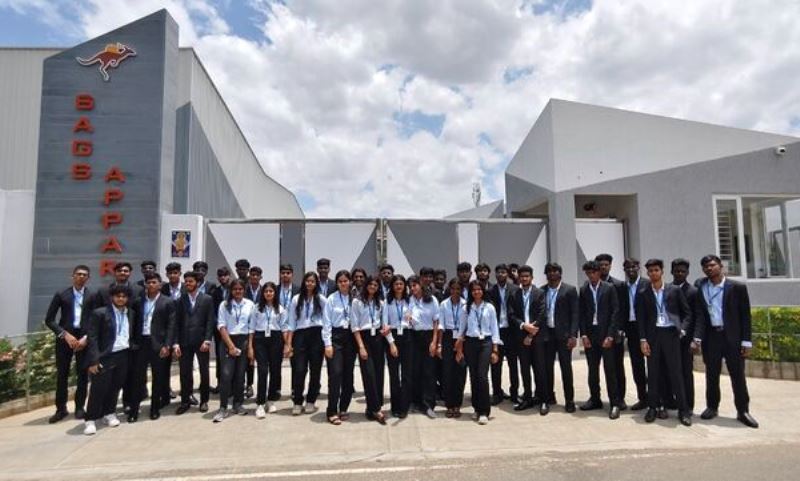
When U.S. President Donald Trump announced a steep 50% tariff on Indian textile exports on August 27, 2025, the shockwaves were felt instantly across Tiruppur — the country’s knitwear capital. But for SAGS Apparels, the disruption became a catalyst to showcase what true resilience and sustainable transformation can look like.
Right in the heart of the city stands Samya — an architectural and environmental milestone. Designed by Coimbatore-based Arun & Associates, the 52,900 sq.ft. facility features a dynamic glass façade that plays with optical illusion, lush landscaping across one-third of the site, and naturally lit workspaces supporting over 400 staff.
Built to meet LEED Platinum standards, the factory is a net-zero facility for energy, water, waste, and carbon — a rarity not just in India, but globally.
A Factory Built on Balance and Sustainability
“From day one, we asked: how do we reduce environmental footprint at every step?” says architect Arun Prasad Prakashan. His design for Samya — meaning balance, harmony and proportion — prioritises both sustainability and occupant comfort.
Key features include:
Evaporative cooling system that keeps interiors 6°C cooler without air-conditioning
Smart façade to optimise light and heat flow
High-SRI Borescope roofing sheets from Tata to reduce heat absorption
250 kW rooftop solar system, generating 35% more energy than required
5-lakh litre rainwater harvesting tank enabling self-sufficiency for three months
Intelligent borewell recharge system for surplus stormwater
“All office windows open into tree canopies and gardens, bringing a sense of calm,” Prakashan notes.
Sustainable Garments, Global Clients
For Ganesh Anantharaman, managing partner & CEO of SAGS Apparels, the building is an extension of the brand’s ethos.
“We produce sustainable garments using 100% organic and fair-trade cotton. We started with just 30 people. Today we employ 450 and export to premium clients in Germany — from Bundesliga football clubs to Mercedes-Benz,” he says.
The company won the German Sustainable Award in 2020, and its new facility, he says, is meant to inspire local MSMEs to adopt similar standards. “We wanted a building that is iconic and future-ready.”
Green Construction, Zero Waste, Total Discipline
According to Conserve Consultants, the sustainability advisors, the project required rigorous documentation and adherence to green norms.
Among the key measures:
Rich topsoil was preserved during excavation and reused for landscaping
Zero debris or construction waste was sent to landfills
Noise and pollution were tightly controlled
All materials — from paints to furniture — were green certified and sourced within a 300-km radius, despite logistical challenges
The facility also uses performance glass, pre-engineered steel, minimal east–west openings, and drought-tolerant native species for landscaping.
Prepared for the Future — And Tougher Global Rules
With the EU mulling carbon taxes and buyers preferring low-impact manufacturing, sustainability is no longer optional, says Anantharaman.
The company has deployed IoT-enabled water and energy monitoring, automated landscape irrigation, and even hired a full-time “sustainability executive” to track environmental performance across blocks.
“Clean-energy factories are the future. They attract global buyers and future-proof MSMEs,” adds Prakashan. “Soon, green energy codes will be mandatory.”
A Model for India’s Next-Gen Manufacturing
Despite global trade pressures, SAGS Apparels’ commitment to sustainability has turned Samya into a model industrial facility — proving that even MSMEs can achieve world-class green standards.
As Tiruppur recalibrates its strategy amid global headwinds, Samya stands as a testament to innovation, responsibility, and the power of doing what is right — for people and for the planet.