
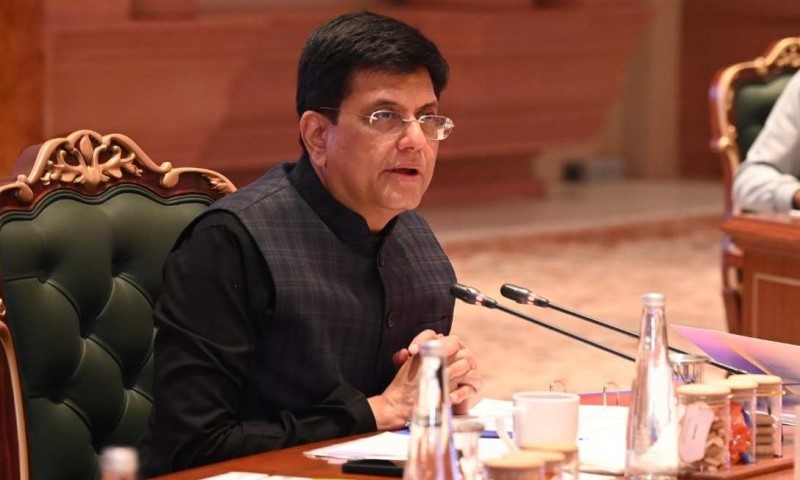
Union Commerce and Industry Minister Piyush Goyal on Sunday hailed the Union Budget 2026–27 as a “future-ready” blueprint that lays the foundation for a developed India (Viksit Bharat) by 2047, with a strong thrust on manufacturing, infrastructure and youth reskilling.
Calling it a budget that inspires growth and dedication, Goyal said the government has prioritised sectors critical to sustaining India’s position as the world’s fastest-growing major economy. “This is a budget for a future-ready India. Manufacturing, inland waterways, high-speed rail corridors, development of tier-2 and tier-3 cities, and reskilling of youth have been key focus areas,” he said.
Dismissing opposition criticism, the minister remarked that such reactions have become routine. “They have a broken record that plays after every Budget. Do they not want development of MSMEs?” he asked.
Sharing highlights on X, Goyal pointed to major announcements for industry and trade under the #ViksitBharatBudget. The Budget has earmarked a record ₹12.2 lakh crore for capital expenditure, underscoring the government’s push to make India’s manufacturing ecosystem globally competitive.
A key announcement was the launch of the India Semiconductor Mission 2.0, aimed at strengthening domestic supply chains and intellectual property capabilities. The initiative is backed by an additional ₹40,000 crore outlay for the Electronics Components Manufacturing Scheme.
To boost logistics and connectivity, the Budget proposes seven new high-speed rail corridors and a ₹10,000 crore allocation for domestic manufacturing of shipping containers, a move expected to ease supply chain constraints and improve India’s export competitiveness.
In a significant boost to small businesses and the life sciences sector, the government announced a ₹10,000 crore SME Growth Fund and the Biopharma SHAKTI scheme to position Indian MSMEs as global players and establish India as a hub for biologics and biosimilars research.
Other notable initiatives include an integrated programme for the labour-intensive textile sector, support to states for three dedicated chemical parks, development of five university townships near major industrial and logistics corridors, AVGC content creator labs in 15,000 secondary schools and 500 colleges, and a scheme to set up five regional hubs for medical tourism.
Together, the measures signal an ambitious roadmap aimed at accelerating industrial growth, job creation and innovation, as India moves steadily towards its Viksit Bharat 2047 vision.