
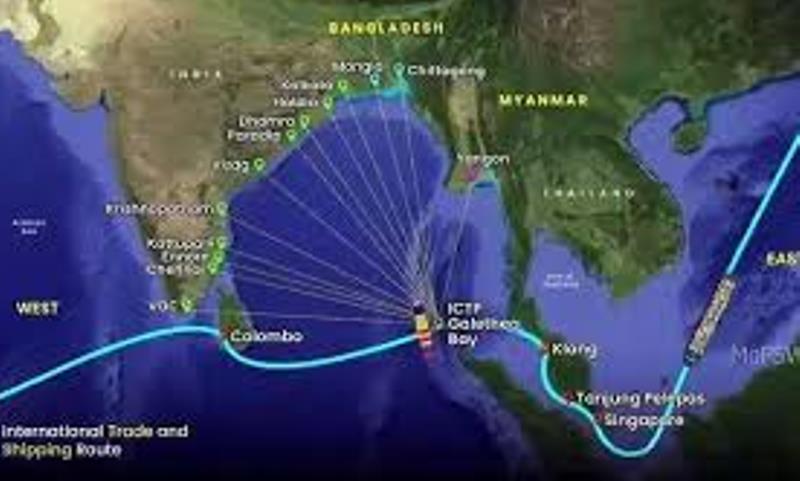
The Union government is considering the development of a deep-water dry bulk cargo transhipment port at Atlanta Bay in Diglipur, North Andaman, in the Andaman and Nicobar Islands, multiple sources said. The proposed facility is envisaged along the lines of the International Container Transhipment Port planned at Galathea Bay in Great Nicobar Island, though officials emphasise that the Atlanta Bay project is being driven primarily by strategic considerations rather than commercial viability.
The proposed port is designed to handle Capesize vessels of up to 200,000 deadweight tonnage (DWT) and would feature a quay length of about 4,000 metres. The decision to examine the feasibility of developing the deep-water port was taken during the seventh Island Development Meeting chaired by Union Home Minister Amit Shah, a government source familiar with the deliberations said.
State-owned Syama Prasad Mookerjee Port Authority (SPMPA), Kolkata, has been tasked with carrying out a detailed techno-commercial feasibility study and preparing a business plan for the project. The government has directed SPMPA to complete the study within six months to assess the technical, economic and logistical dimensions of the proposed dry bulk transhipment hub.
According to sources, the Centre may ask some state-owned major ports to fund the development of the Atlanta Bay project, leveraging their cash reserves to support new port and terminal infrastructure, even if commercial viability remains uncertain. Most major ports, now operating as port authorities, do not pay dividends to the government, and their surplus funds are increasingly being channelled into such projects.
However, the move has reportedly triggered concerns among several major port authorities , which argue that their cash reserves are needed for their own expansion plans, dredging and maintenance works, as well as to meet statutory employee-related liabilities.
Following the Island Development Meeting, the Andaman and Nicobar Administration conducted a pre-feasibility study through the Indian Institute of Technology, Madras, which endorsed the technical suitability of developing a deep-water dry bulk cargo transhipment port at Atlanta Bay.
The government believes the project could significantly enhance trade, connectivity and tourism in the region, while also strengthening India’s maritime security footprint in the strategically sensitive Andaman and Nicobar Islands, according to a document.
Dry bulk transhipment ports serve as critical nodes in global supply chains, facilitating the transfer of unpackaged commodities such as coal, iron ore and grain between large bulk carriers or onward to smaller vessels and land-based transport using specialised handling systems.
Industry experts, however, caution that strategic logic may be outweighing commercial considerations in India’s island port development plans. They point out that the proposed container transhipment terminal at Galathea Bay has itself been widely viewed as commercially unviable due to its distance from the main East–West international shipping route, which would require significant deviation by container vessels — a key deterrent for transhipment traffic.