
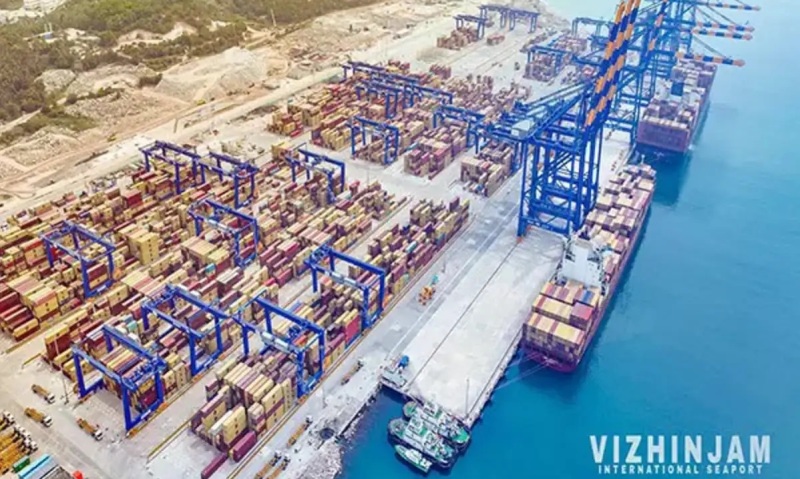
Even as Vizhinjam International Seaport continues to raise its benchmark performance in container handling, Kerala is falling behind in creating a Vizhinjam-driven industrial ecosystem—an essential requirement to fully leverage the potential of one of the world’s largest emerging transshipment hubs.
According to the latest official statistics, Vizhinjam once again emerged as the top-performing port on India’s east and south coasts, recording a container throughput of 1.21 lakh twenty-foot equivalent units (TEUs) in December 2025. This is the highest-ever monthly container volume handled by the port since the commencement of commercial operations in December 2024.
Since operations began, the port has handled around 686 container vessels, including 51 ultra-large container carriers, processing a cumulative cargo volume of 14.6 lakh TEUs. The rapid rise of Vizhinjam as a transshipment hub has started drawing interest from major logistics and shipping players, though tangible progress on the industrial front remains limited.
In a recent social media post, Sanjay Swarup, Chairman and Managing Director of Container Corporation of India Ltd. (CONCOR), said the PSU held a strategic meeting with the Adani Vizhinjam International Seaport authorities. The discussions focused on business development opportunities, integrating port-led infrastructure with CONCOR’s multimodal logistics network, and unlocking value-driven supply chain solutions for both EXIM and domestic cargo.
However, sources said the State government continues to lag in acquiring and allotting land to prospective investors. Although there is reported interest for around 500 acres from potential investors, no major breakthrough has been achieved so far.
A year into commercial operations, Kerala is yet to identify land even for an empty container yard near the port, considered a basic prerequisite for any transshipment hub. A trailer truck terminal has also not materialised in the region. In contrast, neighbouring States such as Tamil Nadu and Karnataka handle nearly 2 million TEUs of gateway cargo each annually, supported by strong industrial and logistics ecosystems.
Kerala, meanwhile, handles only about 1.5 lakh TEUs of gateway cargo, primarily due to the absence of port-linked industries and supporting infrastructure, sources said.
Officials pointed out that Vizhinjam has the unique advantage of being able to connect with 107 leading transshipment hubs globally, a capability unmatched by any other Indian port. Yet, without a robust industrial ecosystem and logistics backbone, the State risks missing out on the full economic benefits of this strategic maritime asset, they cautioned.