
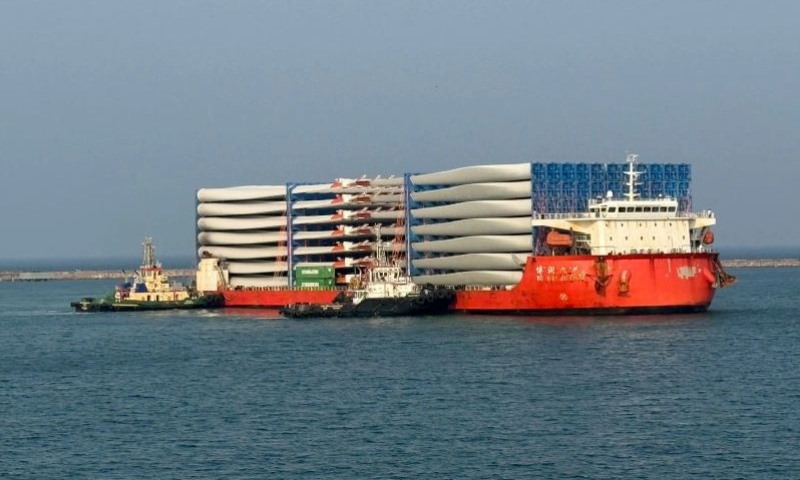
V.O. Chidambaranar Port Authority (VOCPA) is strengthening its position as a key logistics hub for India’s renewable energy sector, with a significant rise in the handling of wind turbine blades and other oversized clean-energy cargo.
During April–August 2026, VOC Port handled 2,188 wind turbine blades, compared with 1,254 blades during the corresponding period of FY 2025–26, registering a 74.5% year-on-year growth. The number of vessels carrying wind turbine blade consignments also increased from 39 to 52 during the period.
The growth follows a sustained increase in wind-energy cargo handled by the Port. VOC Port handled 2,030 blades in FY 2023–24, 2,635 blades in FY 2024–25 and a record 4,922 blades in FY 2025–26, with the latest annual volume representing an 86.8% increase over the previous financial year.
To support the growing cargo segment, VOC Port has developed dedicated infrastructure for the storage and handling of wind turbine blades and other over-dimensional components. The Port provides 1,00,000 sq m of exclusive open space outside the Customs-notified area and 1,44,000 sq m within the Customs-notified area for wind-energy cargo. Berths 5, 6 and 7 together offer around 1,00,000 sq m of paved area for cargo handling and storage.
The Port has demonstrated the capability to handle wind turbine blades of up to 90.2 metres in length. Its operations are supported by harbour mobile cranes, trained manpower experienced in over-dimensional cargo handling and road connectivity linking the Port with its hinterland.
Shri Susanta Kumar Purohit, IRSEE, Chairperson, V.O. Chidambaranar Port Authority, said the transition towards clean energy was creating new logistics requirements for Indian ports, with renewable-energy projects increasingly dependent on the efficient movement of large and specialised components.
He said the Port was steadily strengthening its infrastructure, handling capabilities and connectivity to serve the growing renewable-energy supply chain and build VOC Port as a dependable gateway for renewable-energy cargo.
With wind turbines and their components continuing to increase in size, the logistics ecosystem required for their movement is also becoming more specialised. VOC Port’s dedicated storage areas, specialised cargo-handling capabilities and hinterland connectivity position it to support the evolving requirements of India’s wind-energy industry.
The continued rise in wind turbine blade volumes highlights VOC Port’s growing role as an important logistics node supporting India’s renewable-energy and clean-energy transition.