
The Port of Antwerp-Bruges has served as the setting for a series of demonstrations showcasing autonomous transport technologies currently being trialled in complex logistics environments.
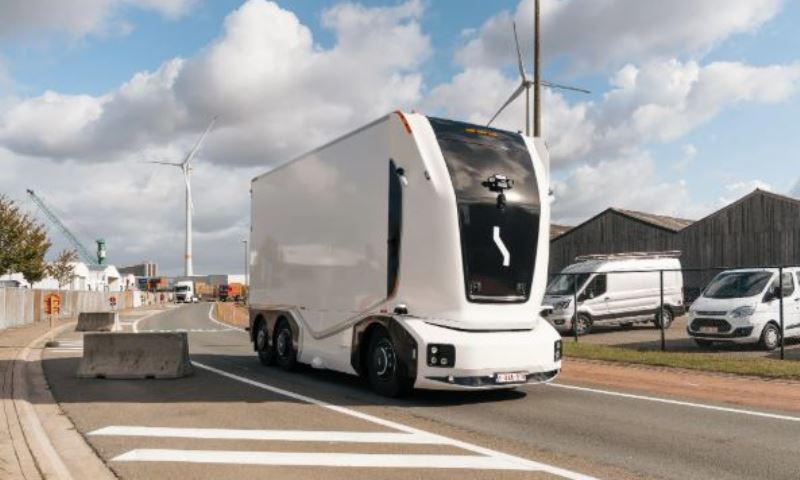
A key milestone was reached with the first operation of a fully autonomous heavy-duty truck on public roads in Belgium.
Developed by Swedish technology firm Einride, the cabless vehicle navigates using an integrated system of LIDAR, radar, and cameras, providing 360-degree situational awareness.
Transport operations are monitored remotely via an AI-powered control centre, allowing a single operator to oversee multiple vehicles.
Henrik Green, CTO and General Manager for Einride Autonomous Technologies, said: “Today in Antwerp, we showcase how public and private sectors can come together toward shared goals.
“European Ports, such as Antwerp-Bruges, are essential for decarbonising logistics and secure our supply chains; and with the European Commission acknowledging autonomous vehicles as key to EU competitiveness, we’re proud to showcase a clear example of how innovation and regulation can be balanced for safer, more efficient and sustainable logistics.”
The Port of Antwerp-Bruges is testing a range of autonomous systems, including drones for monitoring and inspection, remotely piloted vehicles, and uncrewed or semi-autonomous vessels.
These technologies are intended to enhance safety by reducing human exposure to high-risk and repetitive tasks, while also improving efficiency and lowering emissions.
The port has emerged as a preferred testing ground due to its operational complexity and scale.
Trials are being supported by public and private sector collaboration, alongside regulatory efforts at the European, federal, and Flemish levels to create “sandbox” environments for emerging technologies.
Jacques Vandermeiren, CEO of Port of Antwerp-Bruges, stated: “With this event, we are demonstrating that autonomy in our port is not a distant concept. Autonomous solutions are already making us smarter, safer and more sustainable today. And that is exactly what we need to continue to strengthen our role as a world port. After all, we want to be a gateway for goods, but also a gateway to the future.”
The port’s ongoing focus on automation is closely tied to broader objectives around climate performance, cost control, and global competitiveness in the maritime and logistics sectors.
In July, the Sri Lanka Ports Authority (SLPA) delegation visited the Port of Antwerp-Bruges to advance cooperation on port operations, digital innovation, and sustainability.