
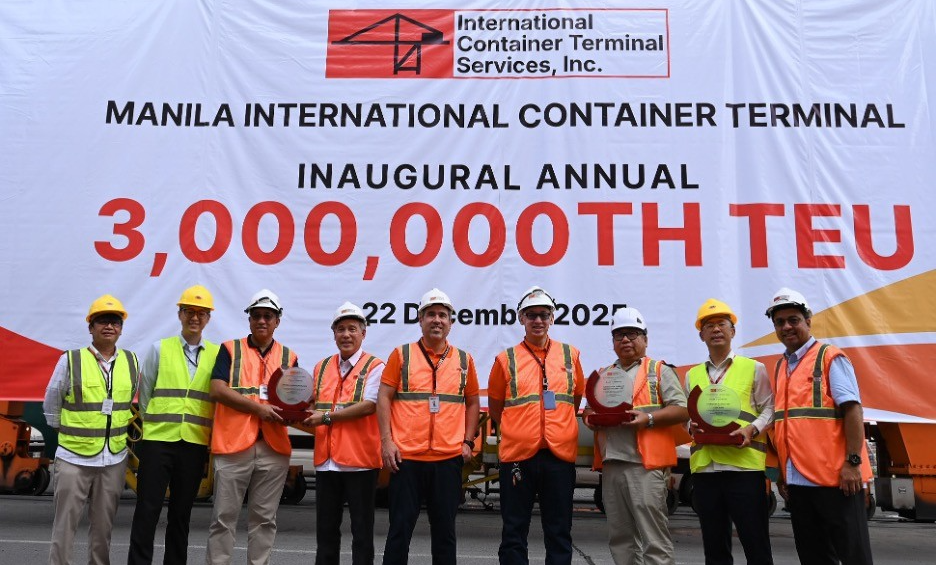
The Manila International Container Terminal (MICT), the flagship facility of International Container Terminal Services Inc. (ICTSI) and the Philippines’ leading international trade gateway, has achieved a historic milestone by handling a record three million twenty-foot equivalent units (TEUs) in 2025—the first time the terminal has reached this level in a single year.
The milestone container was handled on December 22, when MICT serviced the container vessel Ever Bliss, operated by Evergreen Marine Corp., carrying cargo for Universal Robina Corp.
Christian Lozano, chief executive officer of MICT, said the achievement highlights the terminal’s ability to manage rising cargo volumes while maintaining service efficiency, particularly during peak periods. “Handling three million TEUs shows how the MICT has kept pace with rising demand through continued operational improvements and capacity expansion,” Lozano said.
The strong performance was supported by sustained investments in equipment and infrastructure throughout the year. These included the deployment of hybrid rubber-tired gantry cranes, the addition of terminal tractors to boost throughput, and the initial rollout of electric terminal tractors as part of the terminal’s broader modernization and sustainability initiatives.
At the same time, construction is progressing on MICT’s eighth berth, a major expansion project featuring a 300-meter quay and a combined quay and yard development spanning 12 hectares. Of the total area, 6.5 hectares are already operational. Designed with a depth of 15 meters, Berth 8 will be capable of accommodating container vessels with capacities of up to 18,000 TEUs, with delivery of three quay cranes scheduled for 2027.
Upon completion of the berth expansion, MICT’s annual handling capacity is expected to increase to 3.5 million TEUs, further strengthening its role as the country’s premier container terminal.
“Our priority is to deliver consistent and efficient service to customers and ensure cargo continues to move reliably as volumes grow,” Lozano added.
MICT currently accounts for around 70 percent of Manila port volumes and remains the largest and busiest container terminal in the Philippines, serving as a critical gateway for international trade entering and leaving the country.